What’s red or pink or white (if you strip off the skins), or still or bubbly or barrel aged (or not), and outstanding all over? Say it with us: cabernet franc from New York!
No joke. This medium-bodied, super flexible, soup-to-nuts palate pleaser is taking its star turn these days, and for very good reason.
While this red grape originally hails from France, where it holds a vital position in the winemaking traditions of both Bordeaux and the Loire Valley, there’s no need to compare it to those regions. There’s no déjà vu vetting required. It simply is what it is: a beautiful blank slate ready to be seized in our unique growing conditions north to south, east to west in the Empire state — where, indeed, it is very good across the board.
“Cabernet franc tells New York’s story better than any other red wine grape. It’s versatile, resilient and deeply expressive of place — whether it’s grown on Long Island, around the Finger Lakes, or in the Hudson Valley,” says Sam Filler, executive director of the New York Wine & Grape Foundation.
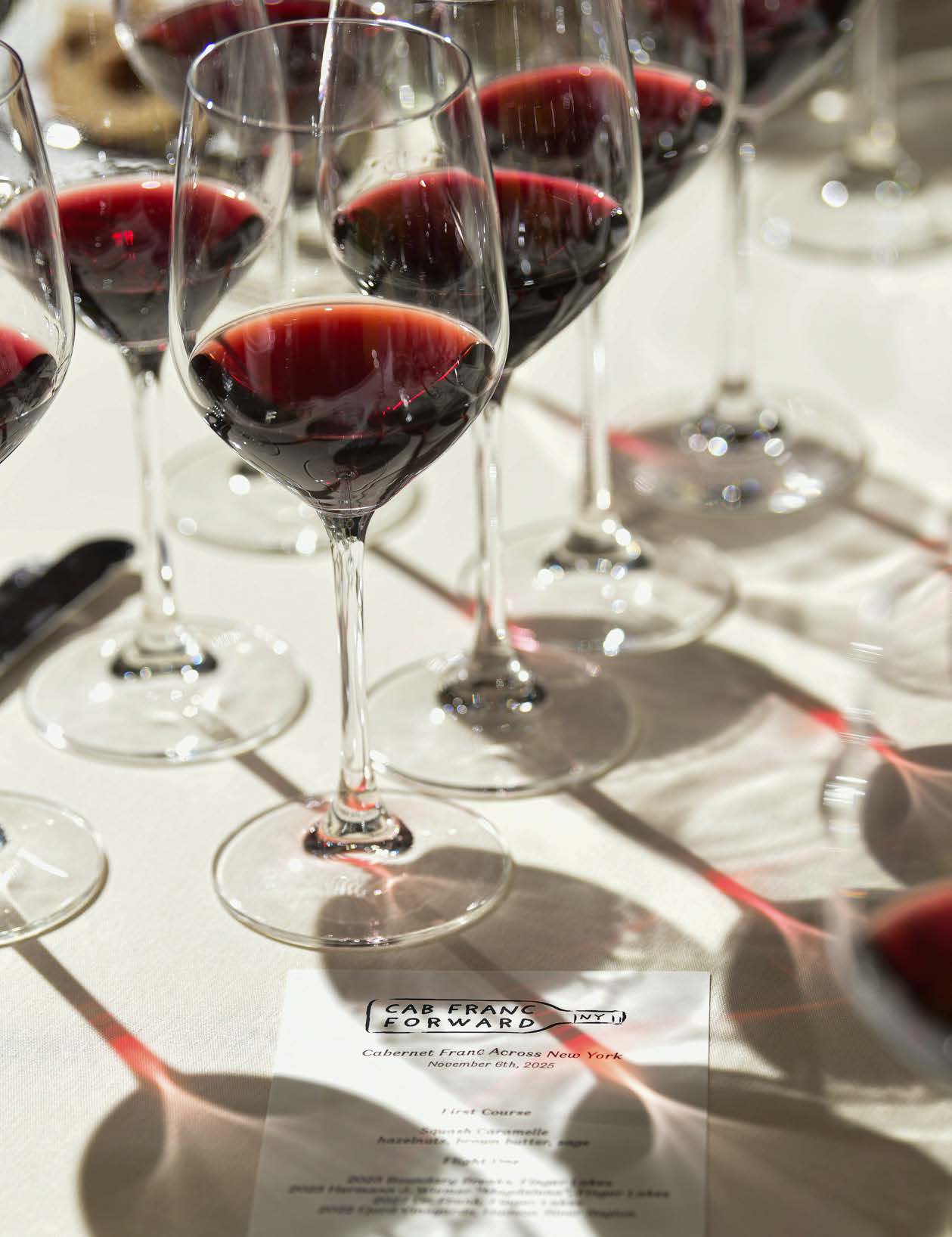
But like any fascinating tale for the ages, sometimes you need a good narrator to tell that story. Enter Cab Franc Forward, a group of eight founding New York wineries that have stepped up to pour out the plot of cabernet franc.
And what a delicious story it is.
A GRAPE FINDS ITS GROOVE
Cab Franc Forward is the brainchild of Gabriella Macari of Macari Vineyards and Max Rohn of Wölffer Estate Vineyard, both of whose wineries make sundry excellent versions. It began as a sort of connect-the-dots notion that they and other like-minded producers began to note, like a smattering of seemingly unrelated stars that, when looked upon the right way, create a beautiful constellation for the ages.
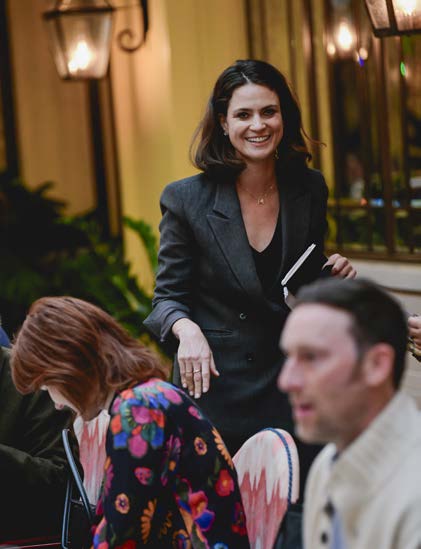

Through tastings with producers from all over the state, dinners, educational opportunities and partnerships with wine shops, Cab Franc Forward founders Gabriella Macari (left) and Max Rohn (right) have raised both consumer and trade awareness (and demand) for N.Y.-made cabernet franc.
“I think for me, the short goal is to get the wine in people’s glass, right?” laughs Macari. “Once it’s in front of you, there’s really nothing we need to say and that’s the beauty. You know, if the wines were bad, we’d have to do a lot more talking and convincing!”
Indeed, it seems like more and more, New York’s excellent versions are showing up not just on the shelves of wine shops but on menus at local spots like North Fork Table & Inn, Demarchelier, Nookie’s, Frisky Oyster, Hellenic, Legends, The Old Mill Inn, The Soundview, The Pridwin, and further afield in New York City at places like The Marshal and Aldo Sohm Wine Bar. There’s even a full-on New York cabernet franc section of the wine list at Smith & Wollensky, among many others.
“It seems like the movement is happening even without us… we were definitely seeing cabernet franc grow in its recognition, certainly within the Wölffer portfolio. And then when you speak to other wineries, it was the same thing with them,” says Rohn, who, along with Macari and Paumanok winemaker Kareem Massoud, were joined by upstate producers Milea, Boundary Breaks, Fjord, Hermann J. Wiemer and Dr. Konstantin Frank. But their collective, consistent efforts in events like their winter Grand Tasting, now in its second year, organized special dinners with dialed-in menus born of chef and winemaker collaborations, and retail promotions and partnerships, have caught the attention of wine luminaries like James Suckling, Alder Yarrow and Eric Asimov, plus many others.
“It all comes into light that cabernet franc is New York’s grape. You see that with the Hudson Valley with their own initiative. You certainly see it in the Finger Lakes,” says Rohn. On Long Island, I was a full proponent of merlot but you started to see cabernet franc just start to happen on its own and, frankly, Long Island in particular needed to really get behind a grape.”
Before we go any further, let’s clarify something important: well-known grapes around these parts, like merlot and chardonnay, are the source of gorgeous wines on the North and South forks of Long Island, and will continue to be as long as there are vines in the ground here. And you should drink them with all the enjoyment and local pride they deserve! What’s interesting about cabernet franc is it’s been a bit of a slow trot, certainly on Long Island. It took time to figure out a few things in the vineyard in order for it to express itself to its best effect here — to find the fruit at its core and tame the greener, herbier aspects and spice into complements and attributes.
Armed with all that knowledge and experience, cabernet franc is ready to take its place next to the best we grow and make on Long Island — and, as Filler notes, in the rest of the state.
“It became clear that if we’re to really capture this, that it’s important that we get together as a state and do it, and that’s something that Gabriella and I have pushed right from the beginning,” continues Rohn. “We’re going to be stronger together. [We] went out to find, to create a coalition of really like-minded wineries that believed in quality, that believed in being out there in the market and were willing to help push.”
YOUR BEST DINNER DATE
Beyond all the viticulture and winemaking kudos, the thing that matters most, of course, is what it tastes like and the ease with which you can open and share different bottles — regardless of who’s at your table or, for the most part, what’s on it. And Long Island cabernet franc? It pretty much goes with everything. Full stop.
Long Island cabernet franc in particular tends to be richer and more brooding than lovely but lighter-toned versions from cooler areas upstate. “Many of them I find to be fresh-fruit forward, with blackberry and plum. Sometimes there’s a little bit of soy and umami,” says Amy Racine, partner and beverage director for JF Restaurants, of which North Fork Table & Inn is part.
And it’s precisely that combo — juicy, lit-up, impossible-not-to-love fruit and freshness with some sneaky layers of savoriness — that makes the grape such a winner when flavors (and guests) run the gamut. By nature, cabernet franc just hits the spot. The perfect natural kiss of tannin. Not too summery light and not too winter heavy. If Goldilocks were of drinking age and found a bottle at the three bears’ house, it certainly would have been among her “juuuuust right!” judgment calls.
“They’re medium-bodied and bright and can go with fish that’s coming from the water just outside. Or it can go with our burger night,” says Racine. “Or it can take you all the way through a meal.”
There’s an embarrassment of juicy riches and myriad styles, from sparkling to rosé to righteous red (or some of ‘em all), right in your home state — and in particular the Long Island AVA.
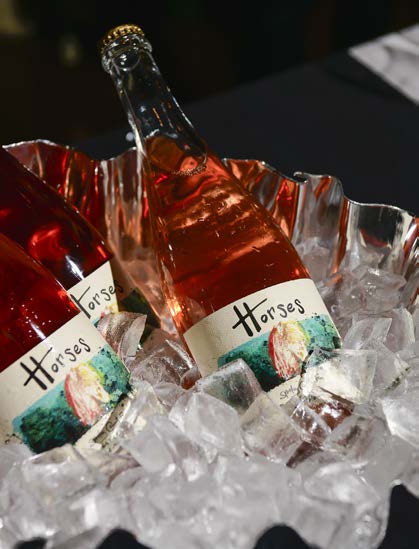
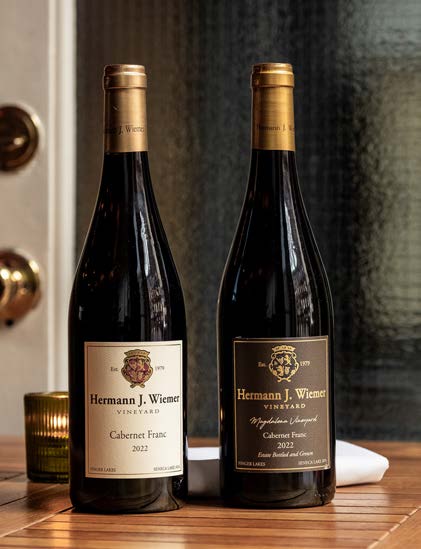
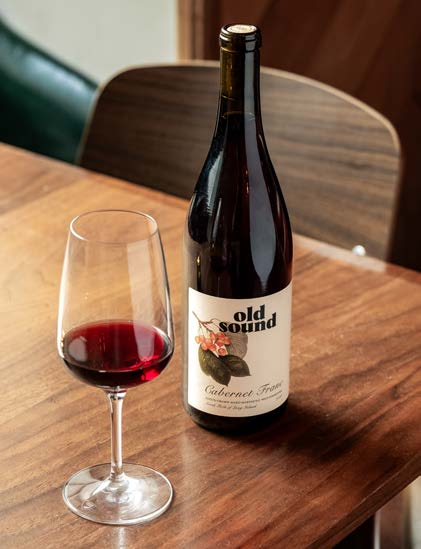
One of the beauties of this grape from the Empire State’s general cool climate is its ability to grow well here and make myriad lovely expressions, from rosé to sparkling to light, fruit-forward style reds to more savory and extracted versions.
At Vintage Mattituck, fine-wine buyer Nate Mendelson has had a lot of fun curating New York-centric cab franc six-packs for both holiday dinners and just plain ol’ exploratory sipping, offering a half-dozen North Fork cabernet franc wines that are not only darned delicious but demonstrate the variety of styles and price points available right in your own backyard.
“Cab franc has all these peppery notes and this crunchy, herbaceous character, but it still finishes off with this red currant, blackberry and raspberry to it — the flavors shine! So we’re trying to put together a collection of wines that really speak to the North Fork,” says Mendelson, a diploma candidate with the Wine & Spirits Education Trust. “From Corey Creek and their white cabernet franc to Macari’s “Lifeforce” which ages in concrete casks, to John Leo, who does two separate cab francs of his own — one co-fermented with malbec and then one aged in French oak. They’re so good!”
Which is probably why, at this point in time, it’s the most widely planted red grape in the entire state of New York and, as of a year ago, the star of the newly launched statewide effort Cab Franc Forward. This collective includes eight core producers from eastern Long Island, all the way to the Finger Lakes and in between, who’ve come together to create different events and activations to show wine lovers just how irresistible and versatile the cab franc from within our Empire State borders is — while bringing other local producers into the fold, too.
And while merlot, once the darling red of Long Island, can really only thrive on the East End, cabernet franc seems to settle in just fine east to west, north to south in the state.
“It’s just at home in New York, and the way it grows. It’s cold hardy and disease resistant and you don’t have to wrestle with it as much as other grapes to get it to where you want it,” says Rohn. “It’s wonderful on the fresher side, like the Finger Lakes is further north, where it’s typically lighter, fresher. And with Long Island being further south, [the wines become] bigger, richer. It just does well at all these levels.”
HAIL A CAB (FRANC)
While cabernet franc wasn’t one of the first vines to go in the ground on Long Island, it’s certainly been around for a good bit.
“We had the first merlot east of the Rockies but we never planted cabernet franc,” says Louisa Hargrave, the matriarch of Long Island wine. “However, around 1980 we leased a vineyard on the North Road that was owned by investors, planted by Dave Mudd. There was an acre there and it was very good quality.”
So good that they planted some of their own around 1984. The year after, Bridgehampton Winery, which folded in 1996, planted cabernet franc, too — the first to do so in the Hamptons. Chris Baiz of The Old Field planted some himself sometime around the late ‘80s and early ‘90s.
According to renowned vineyard manager Sam McCullough, who’s been with Lenz Winery since 1989, there were other scattered plantings but most were bound for blending.
“Lenz had a very small planting from the outset — less than half an acre — but it was never made into a varietal wine. Pindar also has a sizeable planting, although really just a few acres in Peconic. Gristina put in cab franc pretty early, around the mid to late ‘80s,” McCullough recalls, listing other wineries that followed suit: Macari, Pellegrini before it was Pellegrini, Roanoke (“The first one to make a big deal and promote it — it was [owner Richie Pisacano’s] dad’s pet project sometime in the mid to late ‘90s.”) And on and on.
In the ‘90s, winemaker Bruce Schneider stirred up a bit of well-deserved cultlike devotion with his single-variety cabernet francs (some made by Kip Bedell) from his eponymous label, Schneider Vineyards, which drew attention and praise from Wine Spectator on more than one occasion.
But it wasn’t until the last couple of decades that vintners here started to grow and make cab franc in earnest. Armed with experience and improved knowledge about how to best grow and care for it, winemakers began to pull it from behind the blending scenes and into the forefront. You’d be hard-pressed to find any winery on Long Island that isn’t making a standalone version, or at the very least a wine where cabernet franc takes the lead in the blend.
And with very good reason.
“It’s not a super tannic wine. It’s not going to put you to sleep,” says Racine. “From a crowd-pleasing point of view, I’ve never poured the cabernet franc for anybody and they’ve been like, ‘I don’t like this.’ It’s not a polarizing grape.”
As Cab Franc Forward continues to gain steam and pour out the good word, franc in your glass may well finally become the Empire State’s official vinous calling card.
“What we’re seeing is confidence,” says Fillers. “Growers and winemakers know this grape works here, and consumers are starting to recognize it as a true New York original.”