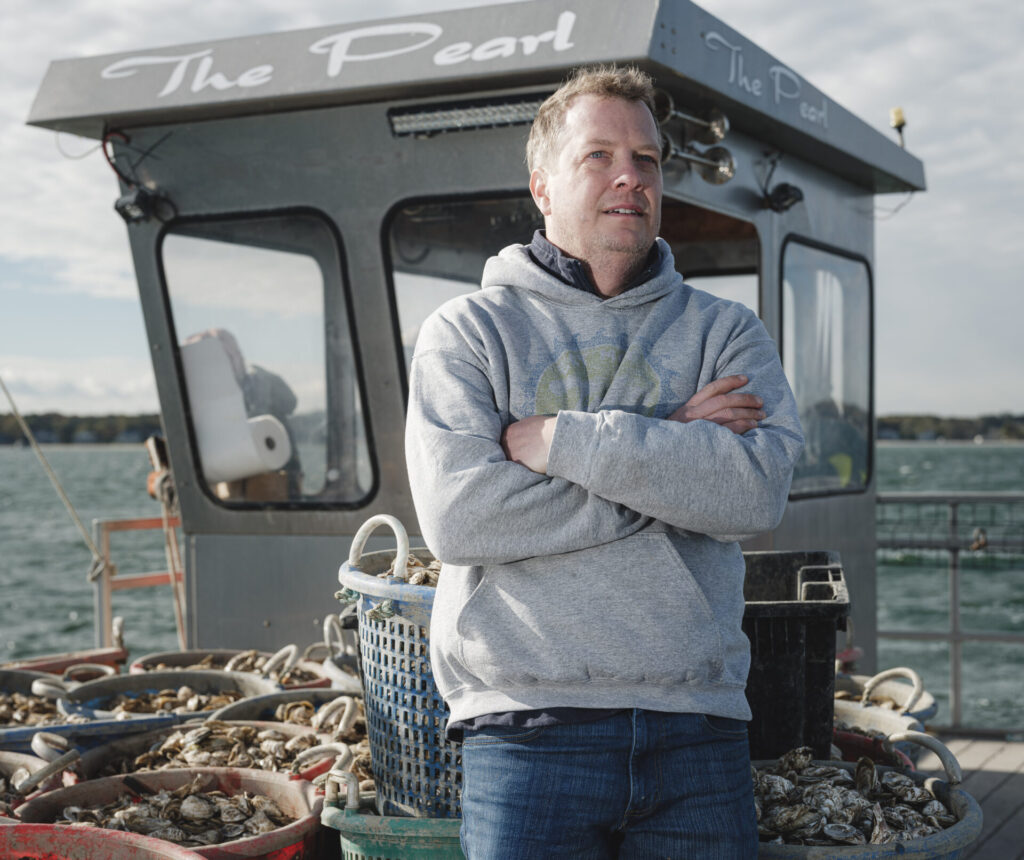
Peter Stein started Peeko Oysters, based in the old Captain Marty’s Fishing Station in New Suffolk, eight years ago. During that time, he’s grown his business significantly, moved his family from Manhattan to East Marion, and managed to survive the Covid pandemic, partly by delving into retail sales and tours of his oyster farm.
But he’s no average city expat. The ideas Stein has up his sleeve to scale up his oyster business just may mark him as one of the most innovative aquaculturists in New York State.
GROWING THE OYSTER SUPPLY
The oysters Stein grows under his Peeko brand sell to some of the most prestigious restaurants in New York City—Balthazar, Gramercy Tavern, Oceana and Café Chelsea to name a few, and to an equally impressive list of North Fork eateries—Minnow at the Galley Ho, Claudio’s, The Halyard, The Old Mill, Demarchelier, Duryea’s Orient Point and Waypoint. But with the demand for local oysters growing all the time, one farmer simply can’t feed the massive consumer desire for the bivalve.
According to New York Sea Grant, there are about 45 private oyster farms and three private shellfish hatcheries on Long Island. While some farming of oysters, hard clams and bay scallops is done for restoration purposes, the mostly oyster-based commercial shellfish sector of the industry generated $7.3 million in 2023, according to the U.S. Department of Agriculture’s 2023 Census of Aquaculture. In 2024, 9.4 million cultivated oysters were harvested, the most ever from New York waters.
As East End aquaculturists search for ways to become more efficient and increase their output, Stein has begun to work with one- or two-man oyster operations to explore contract growing; he’s also installed a new, state-of-the-art FlipFarm system that has the potential to get a lot more shellfish on people’s plates.
This past spring, Stein took on the business of processing, marketing and selling quality oysters grown by four small-scale farmers exclusively for Peeko. Through this effort, he’s found parallels to the way the East End’s wine industry operates.
“It’s a useful example to understand the concept,” he says. “We have a well-established viticulture industry, but not every vineyard is making wines; some only grow grapes. They may have 100 acres of grapes … they sell those grapes to, say, Premium Wine Group, who presses, ferments and barrels them. [The grower doesn’t] bottle, label or distribute the wine. That is contract growing.”
Stein points out that there are similar parallels in the poultry, cattle and dairy industries, where animals are raised and their meat, eggs or milk is sold to a buyer who takes care of the processing, marketing and delivery of the product.
“It’s no secret that there’s a lack of infrastructure here,” says Stein, referring to the facilities and equipment that oyster farmers need to support production, like ice, refrigeration, sorting machines and the like. Oyster farmers are largely on their own as far as assembling what’s needed to do their job.
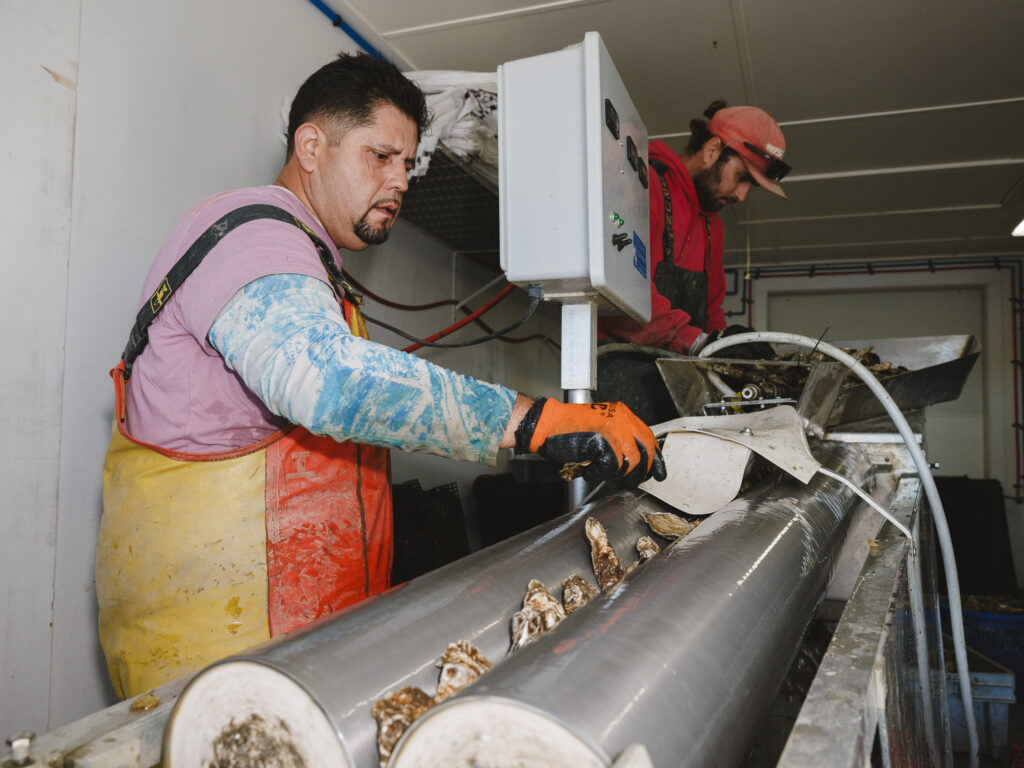
Peeko has its own production facility that Stein has worked hard to assemble — a pristine workspace to process oysters in their New Suffolk shop that’s regularly inspected by the New York State Department of Agriculture and Markets. Many oyster farmers, especially the smaller one- or two-man operations, don’t want to deal with cleaning, sorting, counting, packing, labeling and inspection, let alone the marketing, sale and delivery of the oysters, all of which take time and require space and equipment that may be prohibitively expensive. They just want to be on the water.
“They need trucks, boats, dock space,” says Stein. “They need to maintain their gear and buy seed. Buying 500,000 or 1 million seeds, that’s tens of thousands of dollars per year. A million seeds could be $40,000.”
SMALL-SCALE GROWERS STEP UP
Two years ago, Stein purchased a shellfish hatchery in Southold formerly owned by Karen Rivara, whose work building her oyster brand, Peconic Pearls, earned from Stein the title “matriarch of shellfish aquaculture” on the East End.
Having the hatchery allows Stein to forego paying market price for seed oysters each year. He supplies his contract growers with all the seed they want, with an agreement that they will grow the oysters to size and sell them back to Peeko. The farmers can bring their product directly to him in fish totes, saving them the hassle of grading, counting and packing.
“What we are seeing is [the growers] are stoked,” says Stein. “They may lose a few pennies per pound, but it saves time and effort. If time is money, and one [oyster farmer] doing this has two kids, he can deliver on Monday and Wednesday; now he has a regular schedule. He has a better work-life balance.”


That’s something Stein wholly understands, since he spent years commuting between Manhattan and New Suffolk in the early days of his business, ruing the lost time he could have spent with his wife and young daughter.
Colby Doyon of Islip was the first oyster farmer to work with Stein on a contract basis, starting in March. His business, Fire Island Oyster Company, was able to nearly double oyster production in a single year, going from raising 675,000 oysters in 2024 to 1.1 million oysters in 2025 in the Great South Bay.
“I did 40 to 50 hours of sorting every week,” Doyon says. Eliminating the sorting, marketing and delivery of his oysters “probably amounts to a 30 to 40 percent reduction of labor,” he notes. “We are much more efficient.”
“I have a two- and a four-year-old; the work-life balance is easier to manage,” says Doyon. “I have a set delivery schedule that runs the entire year, which is unheard of in our industry. I don’t miss doing the 1 a.m. deliveries [to Fulton Fish Market].” When Doyon harvests his oysters, Stein meets him at the dock with a van and loads them up immediately.
“As an oyster farmer, you have to wear a lot of hats — farmer, accountant, marketer and delivery person. If I can outsource, I can focus on the farming and growing my business,” Doyon says.
FLIPPING FASTER ON THE FARM
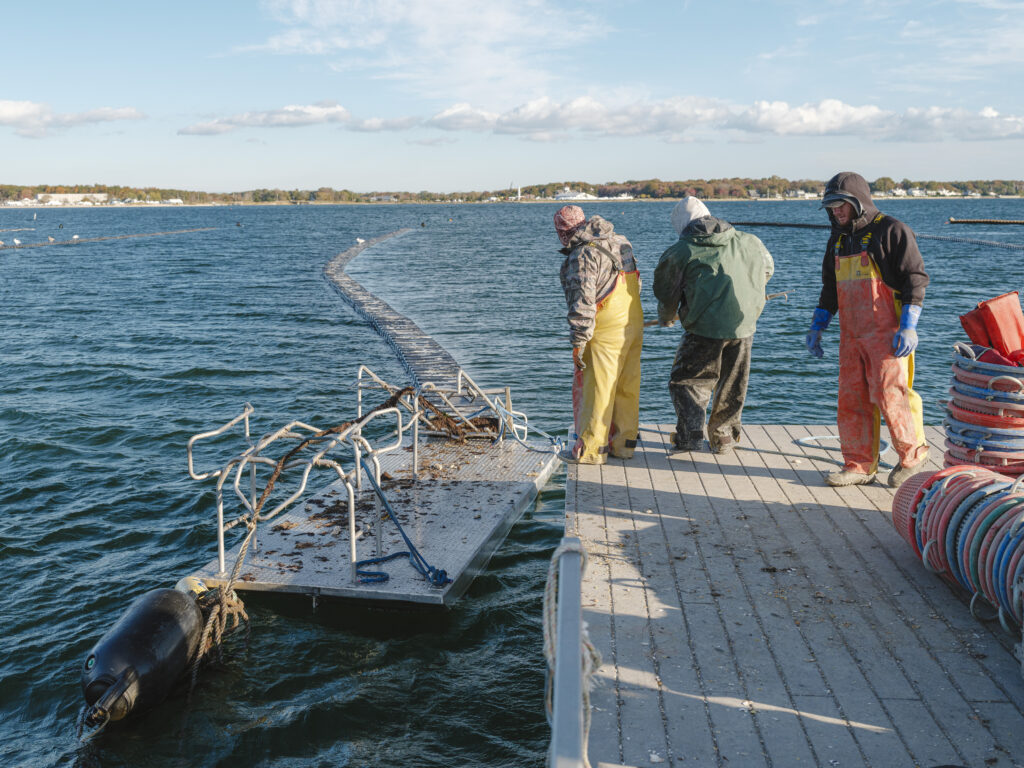
The other innovation Stein is employing to step up growing potential involves new technology in the field: an oyster cultivation system called FlipFarm. Invented in New Zealand, the system entails a line of floating baskets which, with the help of an attachment to the grower’s boat and a platform alongside it, can be easily and quickly filled with new product. The baskets can be rapidly rotated to prevent fouling (the buildup of unwanted materials on the oyster and the baskets, like barnacles and algae) and can be emptied and refilled while standing upright (an enormous benefit to an oyster farmer).
Using the FlipFarm system’s speed and efficiency, the goal is to increase oyster production using the same number of workers and harvesting vessels. FlipFarm’s founder, Aaron Pannell, visited Peeko’s sites in Peconic Bay in late 2024, deeming the location promising for the new system and encouraging Stein to proceed.
Stein owns three locations totaling 400 acres in Peconic and Gardiners Bay, which he purchased from Suffolk County and from individual owners through the years. He made trips to Maine and Louisiana, where the innovative FlipFarm systems had been already installed, and sent Peeko employee Mark Pagano to work on the Louisiana FlipFarm for a week to see exactly how it operated.
Stein then pieced together how much it would cost — a number he declines to reveal, while acknowledging that the full cost of the system was significant. The returns, however, seem worth it, even if putting the FlipFarm system in place was challenging.
“Installing things in the water is difficult,” says Stein. “How do you install it so that it’s clearly marked and so it won’t move? It has to withstand weather. I’ve had many chances to learn how powerful Mother Nature is,” he laughs. An oyster farm set in open water has to resist powerful tides, winds, salt water corrosion and the occasional nor’easter; also difficult is obtaining the permits and paperwork required from New York State, Suffolk County, the U.S. Coast Guard and the Army Corps of Engineers to set up the system. And it must be very well marked to prevent a hazard to navigation.
Peeko submitted plans to the New York State Department of Environmental Conservation, which oversees fisheries activity in the state. While they were receptive, much technical work was required to proceed. Stein hired Advance Diving and Welding of East Quogue, a company with teams of divers who handle underwater construction services, repairs and underwater welding. The divers installed anchors, to which ropes and several large yellow buoys were attached. The installation was lit and marked so that local boat traffic could avoid it.
Although Peeko’s FlipFarm can be seen from the shore, Stein produced a one-page informational flyer for local residents with the exact latitude and longitude of the farm noted, which was handed out at local marinas — Port of Egypt, Albertsons, Goldsmiths and Peconic Bay Yacht Club, and to folks in Beixedon Estates in Southold, a neighborhood close to the FlipFarm site.
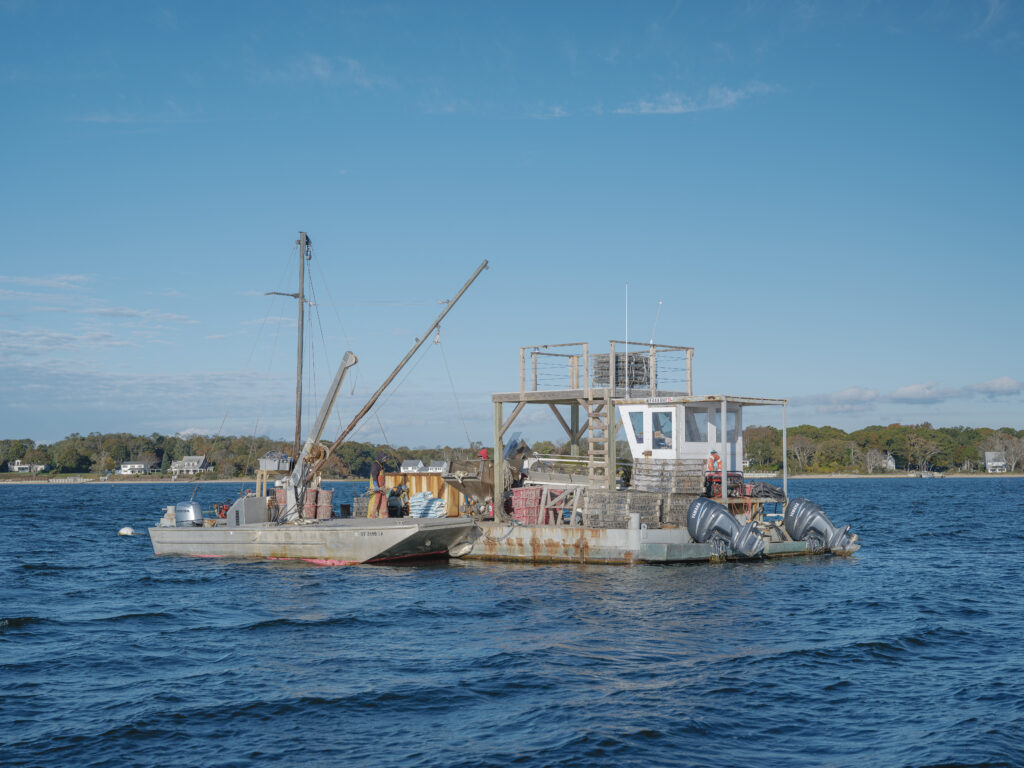
“We want them to know what we are doing upfront,” says Stein. “The site is physically marked. We made sure to use radar reflectors [to be visible on a boat’s radar].” Even though it’s not required, Peeko has plans to mark the farm with high-flyers — vertical poles attached to buoys, used by commercial fishermen as markers and tipped with a reflector that can be seen on GPS and radar. “We try to go above and beyond,” he says.
While the new FlipFarm system has had its hiccups getting up to speed, Stein and his staff see it as very promising. “The first time we harvested out of FlipFarm baskets [this summer] we harvested one bushel every 75 seconds. It would have taken at least three times as long before,” says Stein. “We filled 65 bushel baskets in an hour and 20 minutes.”
Flipping trays of oysters — usually done every week or so throughout the year, rain or wind or shine — is a necessity to prevent fouling of the shellfish and cages. Juvenile oysters also get covered with sea squirts and barnacles quickly, inhibiting the flow of nutrient-rich water over them.
Ordinarily a back-breaking chore, rotating a line of 300 FlipFarm baskets can be done in 90 seconds, says Stein. “Now it’s done in 1/60th of the time,” he notes. The work can be done with a minimum of three crewmembers, but Peeko uses four or five. The original New Zealand FlipFarm is so efficient it can handle 80,000 baskets with a five-person crew.
DOING WELL AND DOING GOOD
Stein is well on his way to improving Peeko’s efficiency by leaps and bounds, but that’s not the only marker of success he’s thinking of.
“What I love about this business is that from day one, we are doing well and doing good at the same time,” he says. “Meaning, I can run a profitable business and stay challenged. I can hire local employees.” Peeko currently has 11 full-time employees, including a new director of marketing.
“And then there’s the sustainability and the environmental aspect of what we do. There are other ways to describe success: social and environmental good. It is very gratifying and it’s something that drew me to the business,” Stein says. “We have a long way to go to achieve what we want as Peeko continues to grow.”