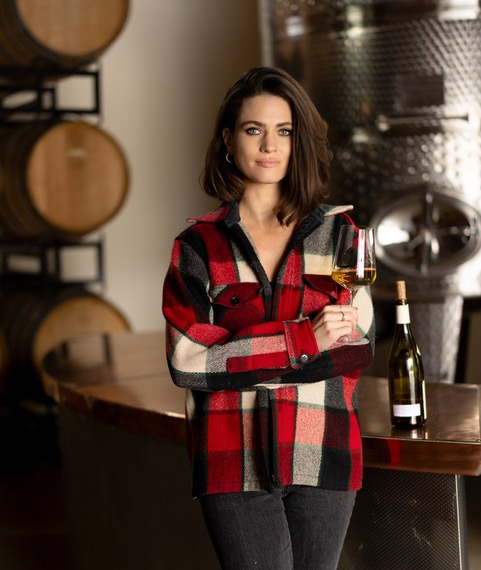
Many have attempted to become a Master of Wine, widely considered to be the world’s most difficult professional credential to achieve. There are only 427 active MWs across 31 countries, who can claim membership in the Institute of Masters of Wine. That elite group just increased by seven who successfully completed the grueling series of exams and papers.
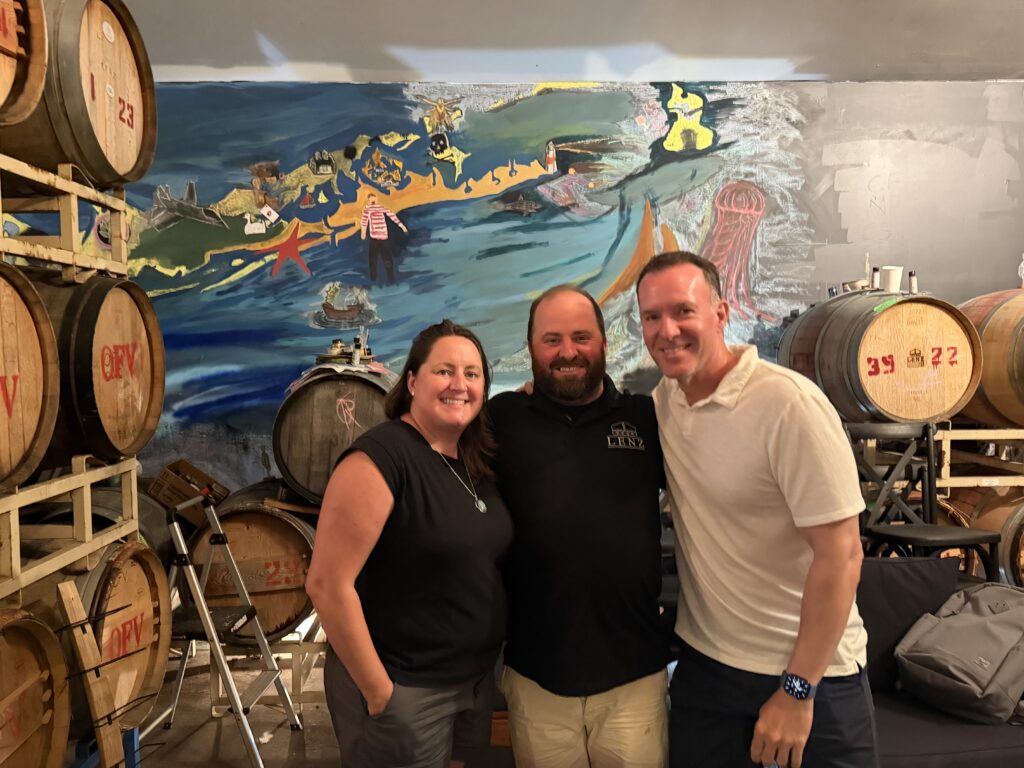
And in that class of seven, announced Aug. 20, only one was from the United States, Gabriella Macari of Mattituck, who became the first MW from the North Fork.
“Fewer than 65 people in the United States hold the Master of Wine title, and now one of them was raised in a New York vineyard,” says Sam Filler, executive director of the New York Wine & Grape Foundation. “Gabriella’s achievement is Long Island’s to celebrate, but it belongs to the whole state.”
The 39-year-old spent nine years in pursuit of the title, the length of time, she says, “reflecting the extraordinary difficulty of the exams and the depth of knowledge required to pass them.” She preceded the master’s program with years of formal study acquiring the Wine and Spirits Education Trust Diploma, a six-segment advanced course of study conceived by the London-based wine education institution and administered through the International Wine Center in Manhattan.
“After completing the Diploma, I realized I had only scratched the surface and that there was still much more to learn. I didn’t hesitate to apply to the MW program, which felt like a natural next step,” she says “[It] was on another level entirely. It required far greater depth, critical thinking, precision and the ability to connect theory to what was in the glass.”
“I’m deeply grateful to everyone for creating the space that allowed me to devote the time and focus needed to complete my studies and achieve this long-held goal.” — Gabriella Macari, MW
At times, her journey was complicated by the COVID-19 pandemic, which interrupted her studies and research paper, but also taxed her to help out on the family winery as it struggled to adapt to new protocols and stay operational. But beyond those logistics, the pandemic took away a critical part of the learning: the ability to meet and taste with a study group.
“We were so isolated, and you really learn in community,” she says. Still, she remained motivated by her long love of learning and academia, which she credits “in no small part to my wonderful teachers at Mattituck High School,” and other New York area MWs who reached out to mentor her.
The course of study is self-directed, consisting of three components: three 12-wine blind tasting papers requiring students to assess variety, origin, winemaking, style and commercial position (price, market and quality category); a theory segment consisting of five papers covering viticulture, vinification, wine handling, the business of wine and contemporary issues; and an in-depth research paper (Macari’s was on consumer behavior study on awareness, perspectives and attitudes towards herbicide use in viticulture).
“At times, I became a complete hermit, surrounded by books and tasting notes in my office,” Macari recalls. But she also changed her scenery, attending residential study seminars in Adelaide, Australia; Odney, England; and Bordeaux, France, and traveled to San Francisco, London and Toronto for the exams.
“The travel was demanding, but it was also among the most rewarding parts of the experience. Learning alongside candidates and MWs from around the world brought the material to life and gave me a much broader perspective,” she says.
Newly minted and still walking on Cloud Nine, Macari says she’ll take some time to decompress and get her life back, including walking her two Border Terriers and her work with Cab Franc Forward, among other projects on the horizon.
She took a moment to reflect on the “it takes a village” effort at the winery that enabled her to study for the exam.
“I’m deeply grateful to everyone for creating the space that allowed me to devote the time and focus needed to complete my studies and achieve this long-held goal,” she says. She can now use the MW post-nominal to indicate her credential.
And though the exam is over, her work is not.
“The knowledge, perspective, and global connections I gained through the MW program will strengthen my work across the wine industry,” she says. “I will always be an ambassador for New York wines! There are so many hardworking, talented viticulturists and winemakers here, and there is no excuse not to support local.”