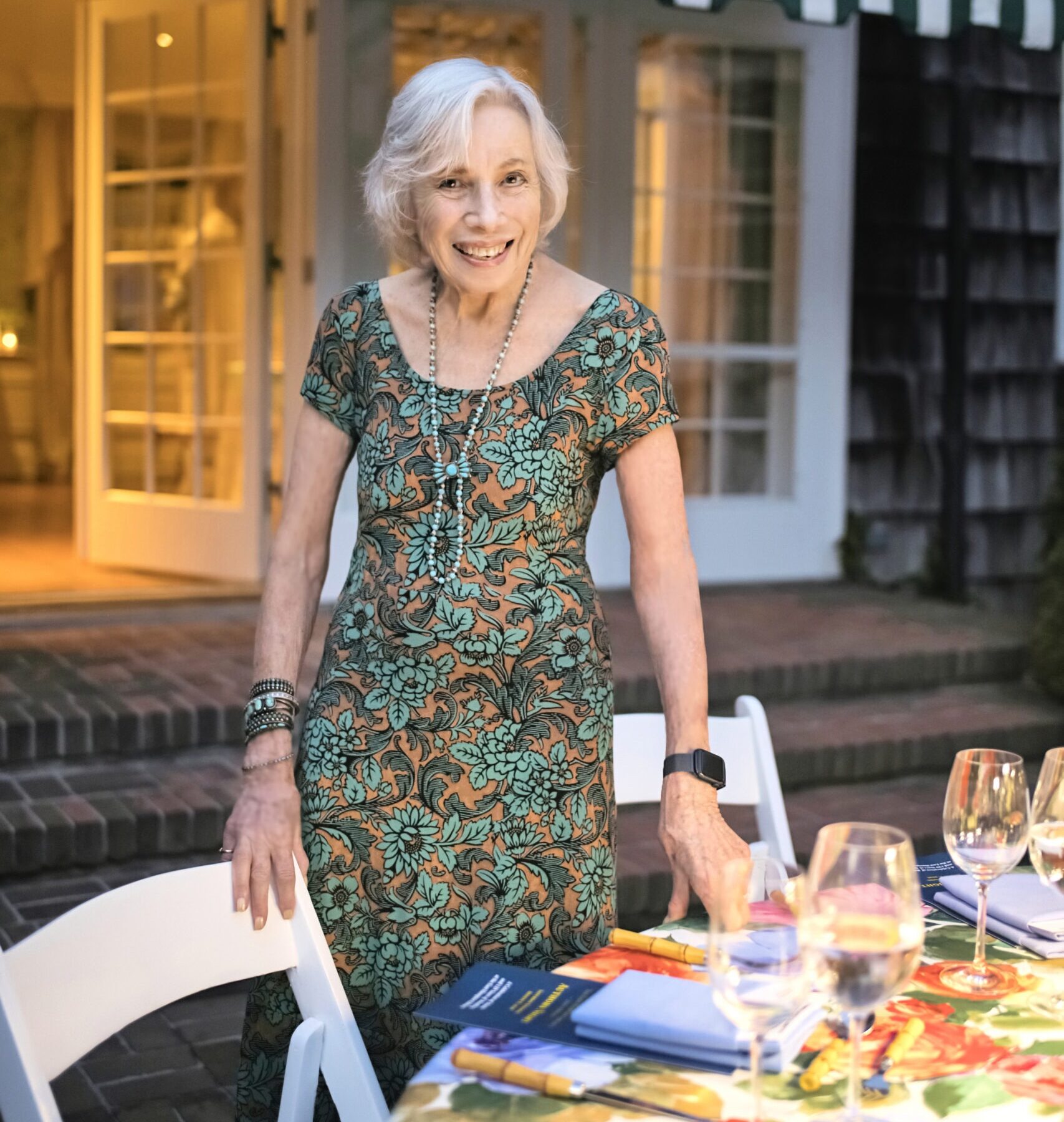
In the world of food writing, there are certain names, past and present, that have become legendary. For nearly 55 years, the name Florence Fabricant has been synonymous with both of-the-moment news (she has a particularly astute talent for gathering hot-plate food world intel), and for her clear-eyed, smart way of presenting it through the lens of her vast experience and the curiosity she brings to it.
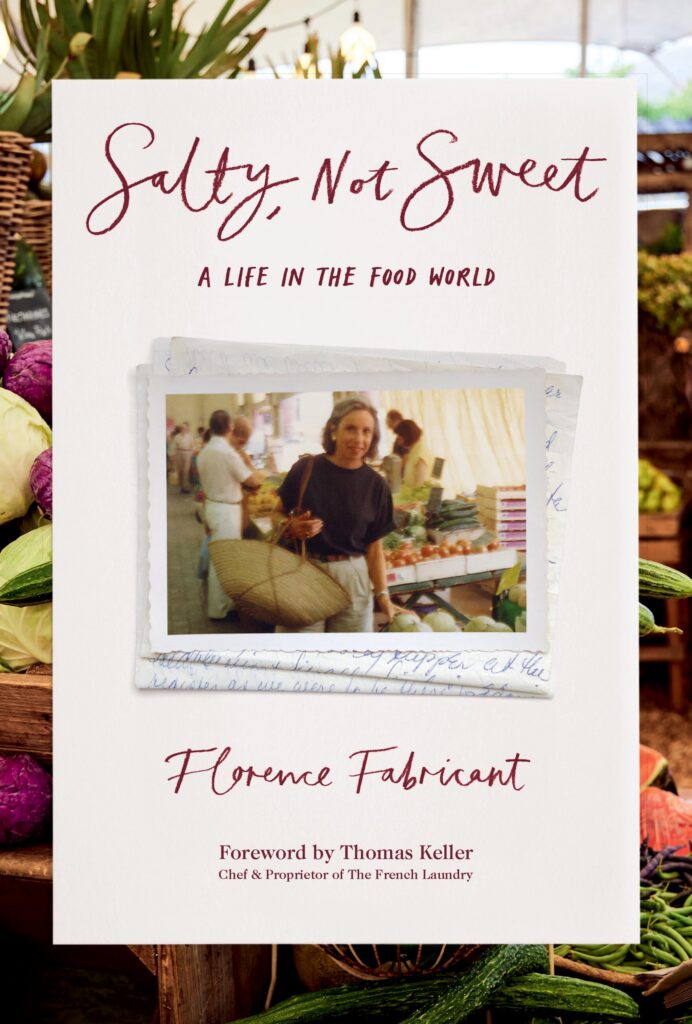
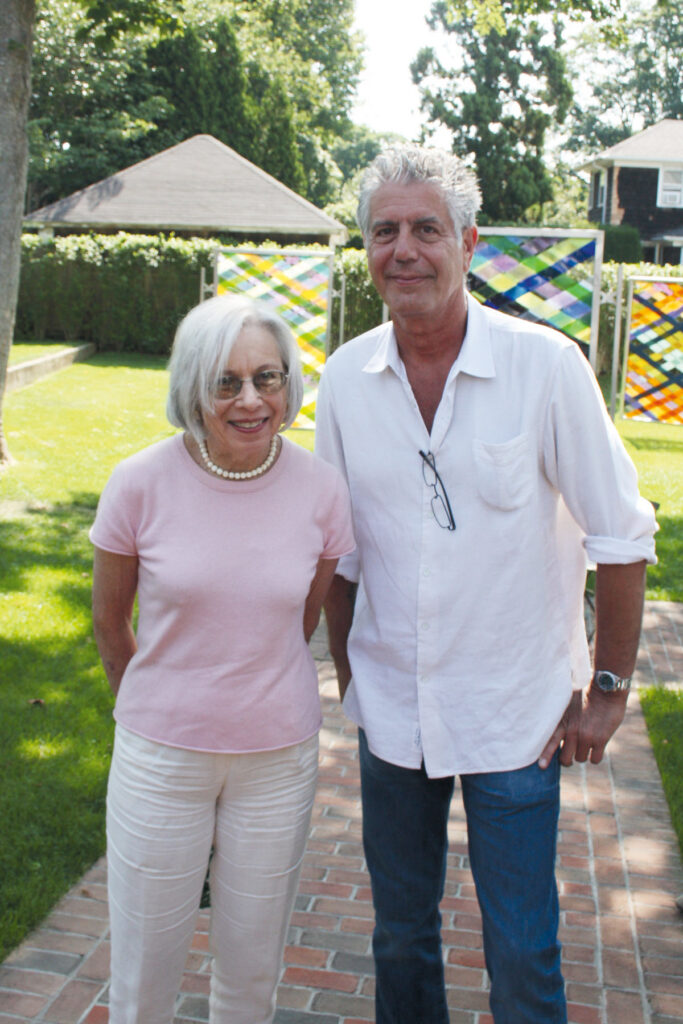
“[Writing a memoir] was something that was kind of on the back burner for a number of years,” says Fabricant. Left, Fabricant’s new memoir was released in october (Photo courtesy of Running Press); right, fabricant with chef and author anthony bourdain at guild hall in east hampton (photo courtesy of guild hall)
This October, at the urging of her friend, the renowned chef Thomas Keller (long before the accolades and storied French Laundry, Fabricant saw his talent as a young chef — maybe even before he did), the part-time East End resident is releasing a memoir, deliciously titled Salty, Not Sweet: A Life in the Food World (Running Press), and it is indeed a tome of savory delights. You have to love a book that opens with the following:
“I am not Joan Didion. And if you cracked open this volume anticipating a memoir that reveals personal trauma, fraught relationships, family troubles and the like, please find another book.”
Classic Fabricant.
She doesn’t suffer fools and she doesn’t hold back, nor would we ever want her to, especially in her work as a tireless advocate for local foodways.
In fact, that’s how she got her start, writing a food column for the East Hampton Star in 1972 after she became utterly disgusted by shoppers loading up on plastic-wrapped iceberg lettuce trucked in from California when there were farms all around them selling fresh, gorgeous produce for the picking.
That led to her long-standing work as a columnist for The New York Times, a multitude of cookbooks, articles, appearances and talks (including her excellent series for Guild Hall, “Stirring the Pot”), all making for a life and point of view well-worth the read (and maybe a second one).
Fifty-plus years in the business is reason enough, but from where you sit: Why did you decide to finally write a memoir?
It was something that was kind of on the back burner — unlit, so to speak — for a number of years. People have suggested it from time to time. Number one, I was too busy, and number two, I just always said to myself, ‘Who would buy this? This is ridiculous.’ There are so many people with similar backgrounds or what have you, so that was that. But then I had the [chef] Thomas Keller moment where he kind of insisted, and that’s when I decided, okay, let’s give it a shot.
In the book you write that “being the first to report on a chef, a restaurant, a trend, or a product has been the internal engine that has driven me throughout my career.” Has this always been part of who you are?
I can remember always being drawn to what’s new. My parents were and I grew up with that kind of mindset — something new and different. Oh, did you hear this? Did you see that? Should we go here? That was very much on the table and kind of followed me throughout my life, this idea of discovery. And then, of course, once you get into journalism it takes on a competitive edge at the same time. It didn’t take me long to understand an exclusive and that aspect of writing about what was happening in the food world.
You’ve been so particularly fervent in expressing how you feel about local food sources and eating in season, and how that also needs to extend to our wine region. There’s still a lot of disconnect with that. What has to happen for a true groundswell to really change the way people eat and drink?
Well, there’s still plenty of uncharted territory, I’ve gotta say. I mean, I remember being taken into the Fulton Fish Market by a guy named Bob Samuel, who was one of the big wholesalers. This was down at South Street in the ‘70s, and he was one of the first people to import Norwegian salmon, and the excitement was palpable. It was gorgeous fish. It was great fish! And of course, at the time, I wrote about that and it was a big discovery. But we know where that’s gone. It was exploited and over time became more of a threat than a treat, and now alternatives are being sought and developed. At the same time, I began to develop an awareness of the fact that just because it’s new and different doesn’t mean it’s good and that kind of cynical ear also drives what I do. You have to be careful what you wish for. The salmon is a perfect example. A book came out about three years ago called The New Fish [by Simen Saetre and Kjetil Ostli], and boy is that an eye opener when it comes to the problems with fish farming. Not all fish farming is bad, but not all of it is good either. It’s put cheap salmon on everybody’s plate, which I try assiduously never to buy.
The LVIS cookbook that I wrote in 2022 is a salmon-free cookbook for that reason. You now have steelhead being produced in the Hudson Valley indoors in a RSA system, and I don’t see anything wrong with it yet, and that’s my go-to. That or Wild Pacific, which is a very controlled fishery, and where you can get the fish from Alaska, and it’s a fishery that’s controlled by the indigenous people. I was also encouraged to see that a company like Fresh Direct is selling wild Alaskan sockeye and king salmon. I think that’s amazing.
If you talk about the Hamptons, and everybody does these days, and the $80 blueberry pie and the $100 lobster salad, and you go into a fish market and people are buying branzino on the East End of Long Island when they can be buying black sea bass, striped bass, local cod, weakfish — you name it — and they’re buying branzino! It brings me back to why I started writing in the first place with the people buying iceberg lettuce in the supermarket when there were farm stands. I mean, it just makes me nuts.
It’s impossible to go to a restaurant and not see someone with a phone over their food, snapping images. What’s your position on social media and dining?
I think social media has been extremely destructive because I think it has put the emphasis on the wrong aspect of food. I’ve never taken a photo of a dish I’ve been served at a restaurant. Please! I’ve got a photo in my head. This idea of concocting something, taking a picture, and then having a million followers go nuts over it — I think it just takes all meaning out of why you enjoy food. You don’t enjoy it just because of the way it looks. There’s some delicious stuff out there that doesn’t look that great. I mean, have you ever had cassoulet? The idea of what food is and what a meal is; not sharing it with a million strangers but sharing it with people at the table. Embedded in the word companionship is P-A-N, which comes from bread. It’s like breaking bread. It’s the sharing and bringing people to the table. That’s important.


Left, a portrait of the food writer (Photo credit: Doug Young); top right, Fabricant interviews Giada De Laurentiis for her series “Stirring the Pot at Guild Hall (Photo credit: Jessica Dalene Photography for Guild Hall); bottom right, Fabricant with chef Tom Colicchio at Guild Hall (Photo credit: Jessica Dalene)
On the East End, food and dining can be very expensive and for many, maybe even out of the range of possibility. When is dining out worth it and when is it not?
If there is an exquisite presentation of beautifully, imaginatively prepared food in a setting that is not noisy and very enjoyable with good service, I would pay a premium for that. I always have. If you find places that can accomplish that, that are not a fortune, all the better. But a lot of those characteristics cost money, and a restaurant that crams in the customers and has a lot of noise and just throws hamburgers at them is probably going to make a lot of money and it is not a matter of the atmosphere or whether it’s worth it or not worth it. I have trouble understanding a lot of menu pricing, but that’s my problem because I don’t eat the portions in the size that they’re usually delivered to me. You’ve got to charge X number of dollars for a 10-ounce steak, but a 10-ounce steak would last me three dinners.
You’ve been so particularly fervent in expressing how you feel about local food sources and eating in season, and how that also needs to extend to our wine region. There’s still a lot of disconnect with that. What has to happen for a true groundswell to really change they way people eat and drink?
Well, I think the public has to come to understand how good the local wine scene has become. We’re talking 50 years of progress. It’s not nothing. There are certain varietals that do particularly well in the Long Island climate and microclimate, notably cab franc and some of the leaner whites. Even chardonnay is produced in a way that puts it on such a different footing from California. Chenin blanc, particularly is an up-and-coming grape to be recognized, but people have this attitude that because it’s local, it has to be cheap. What are they talking about? Consider what it costs to even get material to the East End on those highways, and the time it takes. They just don’t understand the fact that because it’s local doesn’t mean it has to be cheap.
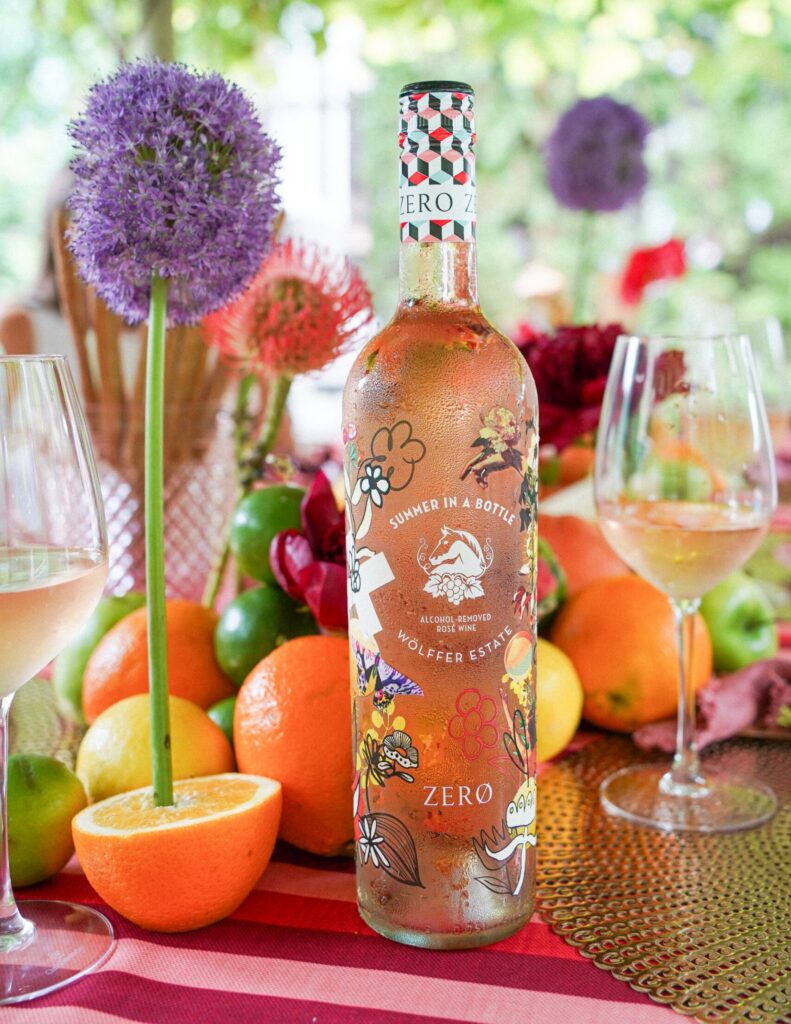
Also, the restaurateurs have to promote it. There are promotional things you can do to introduce people to these wines and to distinguish them, and that doesn’t mean just pouring a few samples in your shop on a Saturday afternoon. Give people incentives like no corkage if you bring a bottle of local wine, or a discount for Long Island wines during Restaurant Week. They’re all drinking Whispering Angel. They’re not drinking Summer in a Bottle from Wölffer, and yet they should be. Let’s be a little chauvinistic! Americans are spoiled because industrial, large-scale farming has kept the price of food down for most of America, and yet at the same time to really appreciate what is special in different regions, you really have to be more tolerant, more flexible, more open. If you live up in Michigan, you’d be eating walleye or some other kind of pike. You’re not going to eat it here, but here you should be eating weakfish, or in the winter you should be frying whiting and have it with your scrambled eggs for brunch. There’s no reason not to. Local oysters have done very well, and if you’re going to sell local Montauk Pearl oysters, sell a bottle of Paumanok chenin blanc with them. There are ways to get people to understand.