This the time of year when the nation of American cooks, regardless of political affiliation, consider important questions of the day: What did our ancestors feast upon, how did they celebrate, and what should we make to honor these culinary traditions? What did Native Americans, European settlers, and the waves of immigrants who followed, serve on that day in November when we give thanks for the harvest, for good food, and for the people around the table?
I like these questions and have spent no small amount of time pursuing links to the past through my kitchen, stirring, rolling, kneading, chopping and hunting down ingredients to find the flavor of days gone by. As chair of the Culinary Historians of New York, I indulge my food obsession by supporting research and dissemination of culinary history. For CHNY members, the past is not forgotten, as long as we can still taste it.
For these Thanksgiving answers, I looked at some of the recipes that North Fork cooks (usually women), have used over centuries, with the help of archivist Amy Folk and the collections she manages at Oysterponds Historical Society; Southold Historical Society and the Town of Southold, and Heather Johnson at Hallockville Museum Farm.
Many of these documents were saved in community cookbooks that raised money for a church or civic group, were locally distributed, and stuffed with favorite recipes of local cooks. Some were a form of advertising produced to sell a product or service to local households, and others were cookbooks with a wide distribution that ended up in the collection of a North Fork cook and were passed down, eventually landing in a historical society collection.
All of them are windows into the past ways of North Fork cooking and eating, whether it’s a holiday or not.
American Cookery by Amelia Simmons, 1796
American Cookery was published in Hartford, Conn., in 1796, and is the first cookbook to provide recipes for the grains, fish and fowl that European settlers found here. Written by Amelia Simmons, about whom very little is known, the book was instantly popular in New York, Boston and Long Island because it was the first American cookbook. It was produced as a pamphlet and priced so low that any household that could afford an almanac could afford American Cookery.
Simmons told 18th century American cooks what to do with corn and how to choose a turkey. The word “cookie” appeared in print for the first time in this book, and Simmons explained how to make cookies with molasses, which was readily available, instead of sugar, which was not. Pumpkin, which she spelled “pompkin,” is another local staple for which Simmons provided recipes, and hers were the first pumpkin pie recipes that bear any similarity to the dish we eat today at Thanksgiving. Her recipe is reprinted on page 73, but to use it, 21st century cooks must either know how to make a pie crust, or where to buy one.
Pompkin
Ingredients
- 1 quart milk
- 1 pint pumpkin
- 4 eggs
- molasses
- allspice
- ginger
Directions
- Mix together in a crust, bake 1 hour.
Receipts and Reminiscences of the Hallock Family and Friends, assembled by Estelle Evans, 1987
Receipts and Reminiscences, a cookbook published in 1987 by Hallockville Museum Farm, is a collection of recipes, quotes and reminiscences going as far back as the 17th century. Estelle Evans, who died in 2020 at 102 and lived in Mattituck until her final years, was the primary author and a culinary historian, although she did not call herself one. She titled the book Receipts and Reminiscences because the word “receipts” is an archaic term for recipes. She was an enthusiastic cook who prepared a fricassee of opossum and tested old recipes on a wood stove.
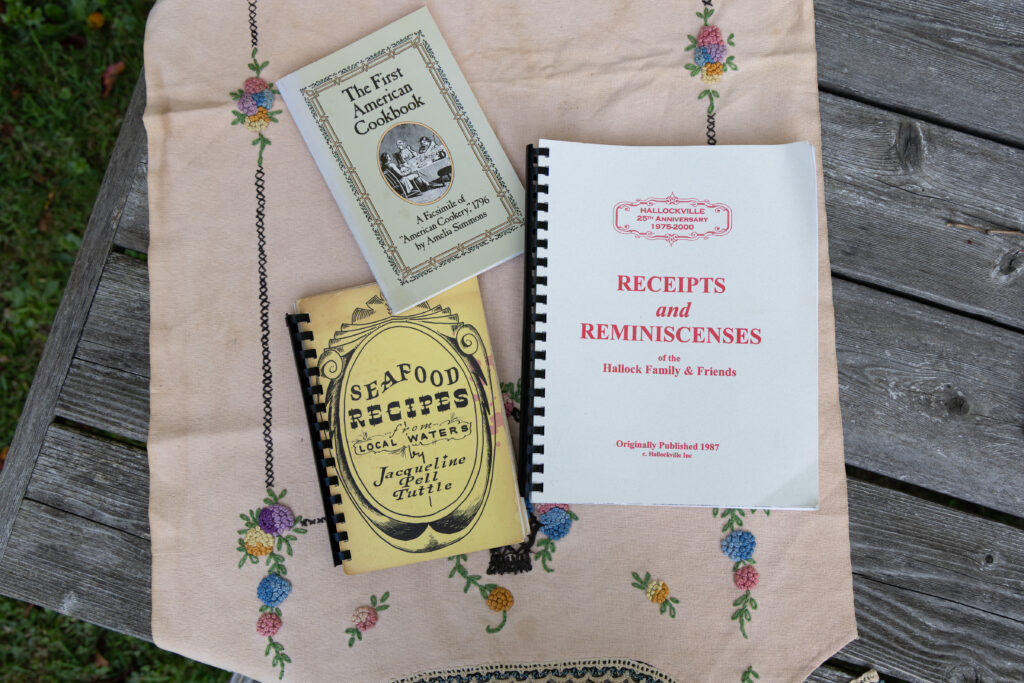
One of her sources is a book called The Practical Cookbook, compiled in 1886 by the Young Ladies Busy Workers Society—a social club of prominent North Fork women, including two daughters of the Hallock family of Sound Avenue. Reading through this collection of recipes, family archives, diaries and oral histories, a vivid picture emerges of the hardscrabble farming life on the North Fork in the 18th and 19th centuries.
Evans devotes three pages of the book to samp, a cornmeal porridge that was a staple for Native Americans and became the staff of life for early settlers, especially when combined with beans and a chunk of salt pork. The book contains menus for Thanksgiving suppers; one at “Aunt Lizzie’s,” with scalloped potatoes, macaroni and cheese, cold boiled ham, piccalilli and cucumber pickles, rusks (a type of bread) and butter, tea, sweet potatoes, canned peaches and chocolate layer cake and apples, and a 1926 Turkey Supper at the Sound Avenue Hall for 150 people. That feast included fruit cocktail, turkey, potatoes, turnips, sweet potatoes, gravy, butter and rolls, pickles, fruit salad, crackers, apple pie, ice cream and coffee; leftover turkey was sold at 55 cents a pound.
The Public Service Radio Cooking School Advertisement, December 1930
During the Depression years, farmers made sure everyone ate, but North Forkers felt the pinch. These years saw the beginnings of food shows delivered into people’s homes by radio, a precursor of today’s Food Network. One that was popular on the North Fork was “The Public Service Radio Cooking School,” whose advertisements (courtesy of the Oysterponds Historical Society) urged listeners to “Tune in Tuesdays and Fridays at 11 a.m.; also Tuesdays at 2 p.m., Station WAAM.” In December 1930, listeners who did learned how to roast a turkey and prepare giblet gravy, chestnut dressing and “potato on the half shell.”
Long Island Seafood Cook Book, by George Frederick and Jean Joyce, 1939
In 1939 the Long Island Seafood Cookbook by George Frederick, president of the Gourmet Society in New York, and recipe-editor Jean Joyce set out to describe and preserve ways of appreciating local Long Island seafood at a time when those culinary traditions were already starting to wane, along with the fish that inspired them. An important record of the kinds of fish that were once caught on the East End, and how local people cooked it, it is still in print, with an introduction full of language that today reads as hilariously sexist:
“One must be ready to accept the special temperament, the changeability, the moods and tenses, the delicacy of approach of sea food, to get the richest treasures from it—quite as one must with [a] woman!”

The book is a collection of hundreds of recipes for Long Island fish and shellfish with the occasional French word in a recipe title, such as chaudiere or bouillabaisse, to fancy things up. Chauvinism aside, the recipes in the Long Island Seafood Cookbook are intensely local, including Riverhead Eel Chowder, Baked Robbins Island Oysters, Aquebogue Oyster Frizee, Broiled Riverhead Mussels, Orient Harbor Smoked Eel, and Plum Island Scallop Fry.
Soft Shell Clams Casino
Ingredients
- 48 soft shell clams (if you can't find them, hard shell are fine)
- 3 slices bacon, diced
- 1/4 cup browned bread crumbs
- 1 tbsp butter
- 1 tsp Worcestershire sauce
- salt and pepper to taste
Directions
- Scrub the clams, pick them over carefully, steam them open and shell. Cut away the hard part, using the soft parts only.
- Select single perfect single shells to serve a plate of 8 per person.
- Fill the shells with the soft parts of two clams.
- On top of each shell, place pieces of diced bacon, some breadcrumbs, a dot of of butter and a dash of Worcestershire. And salt and pepper to taste.
- Bake until they are browned, and serve hot with a relish of choice.
Seafood Recipes from Local Waters, Jacqueline Pell Tuttle, 1972
Jacqueline Pell Tuttle, who is now in her 90s and lives on Shelter Island, brought out the first edition of Seafood Recipes from Local Waters in 1972, a collection of recipes she compiled from cooks on Shelter Island, baymen in Greenport and local restaurants. Illustrated and published by friends in the community, it endures as a record of seafood-eating in the days when many people on the East End still made a living fishing. Tuttle’s family owned a Greenport fish market, and she was motivated to compile the book for customers who came in from the city with no idea how to cook fish.
To read the book is to experience time travel — back to when local waters were full of a variety of fish and it was easy to get. She describes seven different kinds of clams and writes about lobsters and mussels:
“Lobsters can be caught throughout the year, but they are most plentiful in the summer when they come closer inshore.”
and
“The blue-black mussel grows abundantly on the edges of many of our creeks.”
Today, you might be surprised to learn that most clams are farmed elsewhere (mostly on the Eastern Shore and Chesapeake Bay of Virginia), and lobsters and mussels come from the cooler waters of Maine and increasingly, Canada, as the waters here warm.
Some contributed recipes were already considered antique in 1972. To make potted mackerel the way Shelter Island’s Capt. Ed Clark Jr. learned it, you don’t need modern refrigeration, but you do need a bean pot. He called for six mackerel, cleaned, head and tail removed, and cut crosswise into chunks, to go into the bean pot with salt, brown sugar, cloves, bay leaves and pickling spice. The pot is filled with wine vinegar to cover the fish (and dissolve the bones) and then baked in a low oven for four hours. The technique preserved perishable fish until it could be served, usually as a snack or appetizer.
The Shelter Island Historical Society Cookbook, 2013
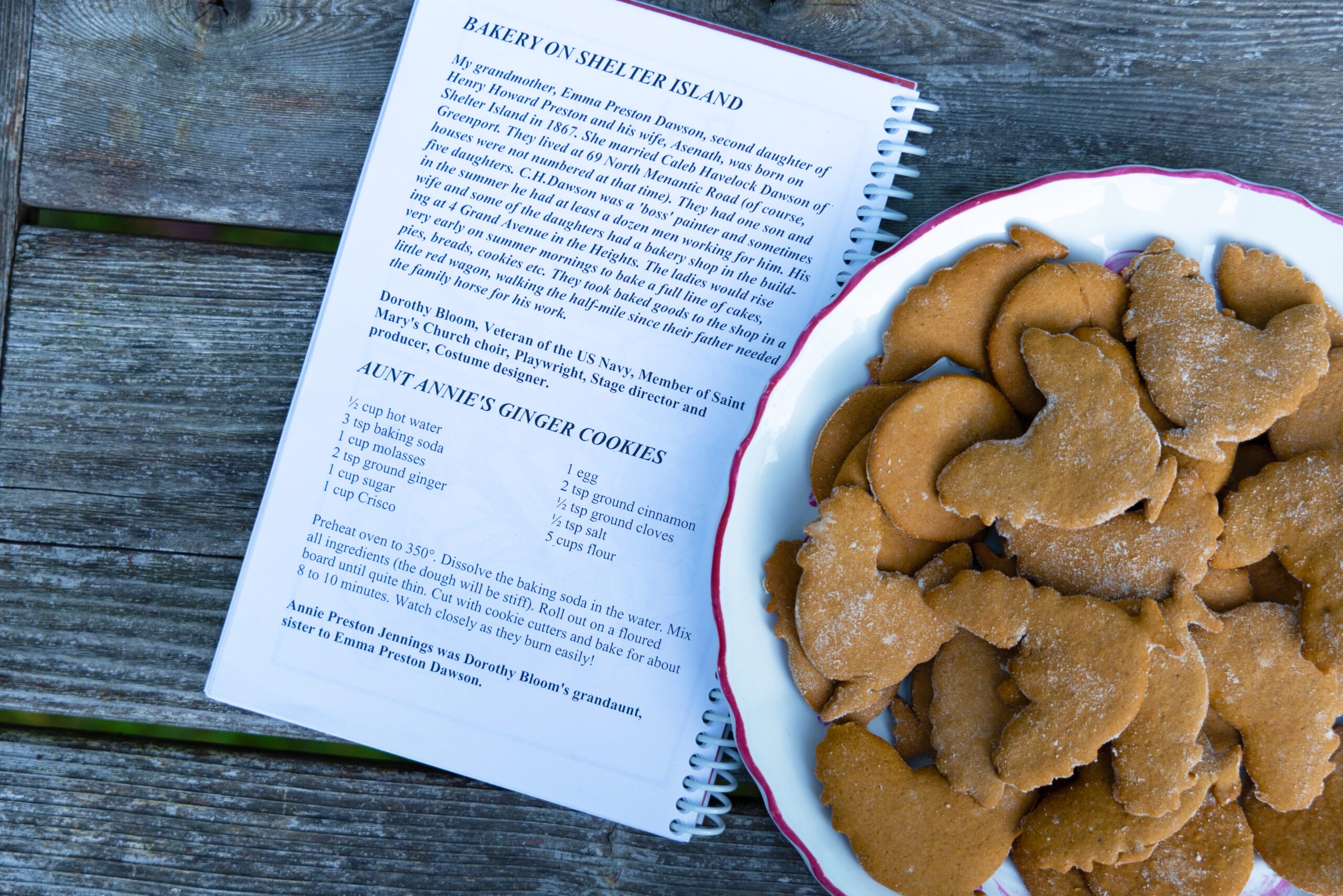
Published as a fundraiser almost 10 years ago, The Shelter Island Historical Society Cookbook is also meant to preserve Island food traditions. Dorothy Bloom’s recipe for Aunt Annie’s Ginger Cookies comes with a brief history of the Shelter Island bakery run by her grandmother in the 19th century, when the cookies were an Island favorite. Thanks to Shelter Island’s community cookbook, you and your Thanksgiving guests can taste the Island’s past.
Aunt Annie’s Ginger Cookies
Ingredients
- 1/2 cup hot water
- 3 tsp baking soda
- 1 cup molasses
- 2 tsp ground ginger
- 1 cup sugar
- 1 cup Crisco
- 1 egg
- 2 tsp ground cinnamon
- 1/2 tsp ground clove
- 1/2 tsp salt
- 5 cups flour
Directions
- Preheat over to 350°F.
- Dissolve the baking soda in the water.
- Mix all ingredients (the dough will be stiff). Roll out on a floured board until quite thin.
- Cut with cookie cutters and bake for about 8-10 minutes. Watch closely as they burn easily!