Erin Argo Burke and Connor Burke, owners and operators of Catapano Dairy Farm in Peconic, are looking for assistance to carry its legacy forward.
The family took over in 2020 from Karen and Michael Catapano, who started the farm in 2003 in Mattituck. The Burkes spent six years rebuilding the herd from 50 to 60 goats to about 100 animals and are looking for someone with vision to take over their established business.
“We don’t want the brand to die,” Erin Burke says. “We think it is an important part of this community.”

The Burke Family. (Photo courtesy of Catapano Dairy Farm)
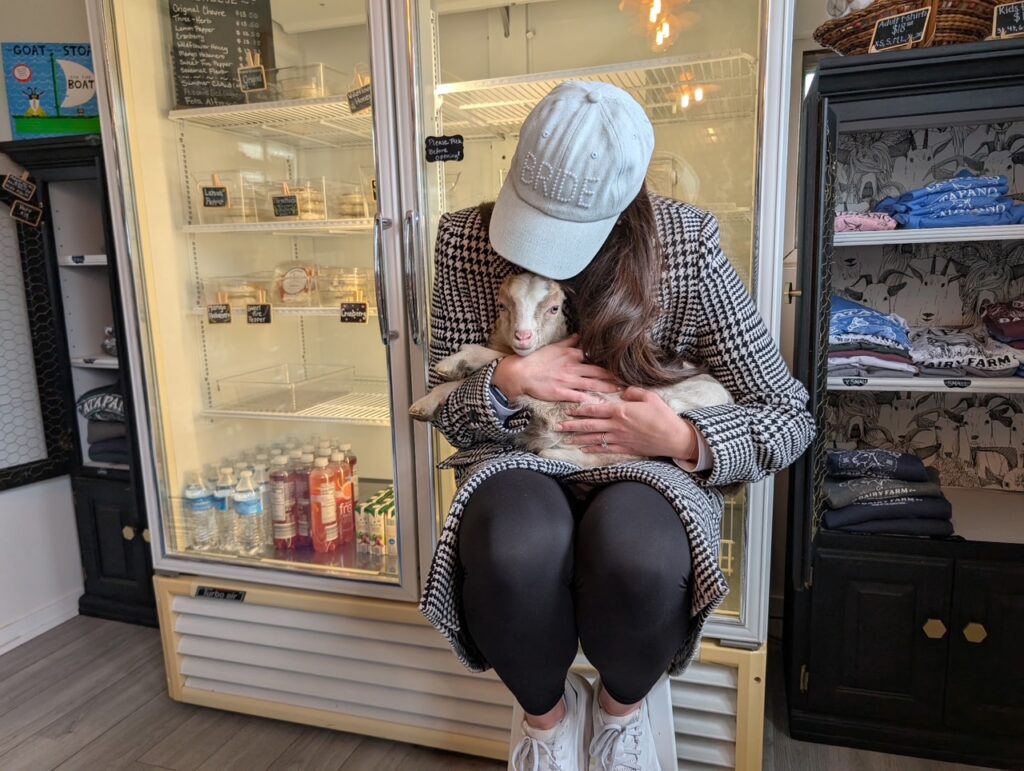
Both the farm’s goats and its products have a devoted following. Its cheeses are sold from their Peconic farm stand and through wholesale accounts, including local farm stands, wineries and specialty food shops. The farm also produces goat-milk soap, hand and body creams, lip balm and other skincare products. Over the past six years, the family expanded the public-facing side of the business with farm tours, cheese tastings, goat yoga, goat-cuddling sessions and private events.
Those efforts have brought joy to visitors. “We love getting to share animals with people, especially people who maybe don’t get to encounter livestock-type animals in their daily lives, and getting to see the joy in their faces,” says Erin Burke. Like most farmers, the Burkes have a very demanding workload.
“Unfortunately, the way our farm is currently set up it is very difficult to scale up,” she says. “I think there are ways to make it financially sustainable. We are willing to sit down and talk to people about ways that you could potentially change things. It’s just going to take an influx of capital to make it happen.”
The dairy’s milking parlor accommodates eight goats at a time, and expanding the herd would require investment in a larger parlor, improved animal housing and other infrastructure. The family recently added seven adjacent acres through the Peconic Land Trust, bringing the property to 12 acres, but the challenge is not acreage alone.
The family operates the farm while maintaining outside careers and raising their two children, Liam and Everett. Erin works as in-house counsel at Stony Brook University, while Connor is training as an arborist and working for Whitmore’s tree farm and landscaping company in East Hampton. Before heading to his day job, he often begins work at 4 a.m. to make South Fork deliveries.
The farm employs one full-time worker and two part-time employees, with the family tending goats, managing herd health, making cheese and skincare products, ordering supplies, staffing the farm stand, overseeing online bookings and handling business administration.
As with many Long Island businesses, expenses have risen recently — grain, hay, freight, fuel, labor, insurance and regulatory compliance all cost more. “We started to understand from talking to our accountant that the realities were such that, unless we raised prices again, we’re going to end up operating at a loss. I don’t want anybody to think that it’s impossible to farm on Long Island, but we need to understand the realities of it, and we are willing and ready to help people manage those realities the best we can. I think the model has to be different,” Erin Burke says.
Such are the challenges of farming on Long Island, where land is expensive and agricultural infrastructure is limited. The farm has navigated state requirements related to its cheese kitchen and employee facilities. Scaling production by purchasing additional milk is possible, the Burkes said, but presents further regulatory and sourcing challenges.
The Burkes feel that there is potential for an entrepreneur, young farmer or a retiree with more time and resources to take advantage of the opportunity. Larger companies have expressed interest in carrying its cheese, and the business has yet to fully explore opportunities such as shipping, expanded wholesale distribution and broader digital marketing. With additional capital, a better-equipped production facility or a dependable outside milk supply, they believe the business could become sustainable at a larger scale.
A successor would not be starting from scratch. The family will transfer cheese and skincare recipes, herd-management knowledge, equipment and wholesale relationships. They are also open to helping a new operator lease the commercial kitchen or pasture space while establishing an independent operation.


The community aspect of catapano has made it about so much more than cheese. (Photos courtesy of Catapano Dairy Farm)
The Burkes see their role as stewards of a farm that has served the community for more than two decades and they intend to preserve its rural character. “The property isn’t developable anyway; it’s all agriculture,” says Erin Burke.
Catapano Dairy Farm plans to remain open through the end of the year, with the goal of identifying a path forward within the next six months. Without a successor, the family expects it may not reopen for the following season.
Interested parties may contact the farm at [email protected] to begin a conversation.