There are eight lighthouses in Southold town, more than any other township in the United States, according to the United States Lighthouse Society. Some of these are familiar landmarks, like the Horton Point lighthouse on the bluff in Southold and the “Coffee Pot” and “Bug Light,” both visible from land and referred to by their local nicknames. Others are more obscure, located further out to sea like the lighthouse at Little Gull Island, or closer to Fishers Island, like the Latimer Reef, Race Rock and North Dumpling lights.
Lighthouses are rock-solid symbols of safety, guidance and strength and a throwback to our maritime history, although their charming appearance can be deceiving. Living and working as a lighthouse keeper is not for the faint of heart, as dealing with rough seas, incoming storms and relentless solitude are all part of the job description.
Yet “people are fascinated by lighthouses,” says Amy Folk, Southold Town Historian. “While we all know they are historic, few realize that today almost all of the lighthouses in the town are over 100 years old.”
The Cross Sound Ferry offers a pleasant and informative Long Island Lights Tour, narrated by marine history expert Ted Webb Sr. of Orient. It includes lighthouses in Connecticut and the site of the abandoned Gardiners Island lighthouse at Fort Tyler, known as “the ruins,” as well as six of the eight Southold Town lighthouses.
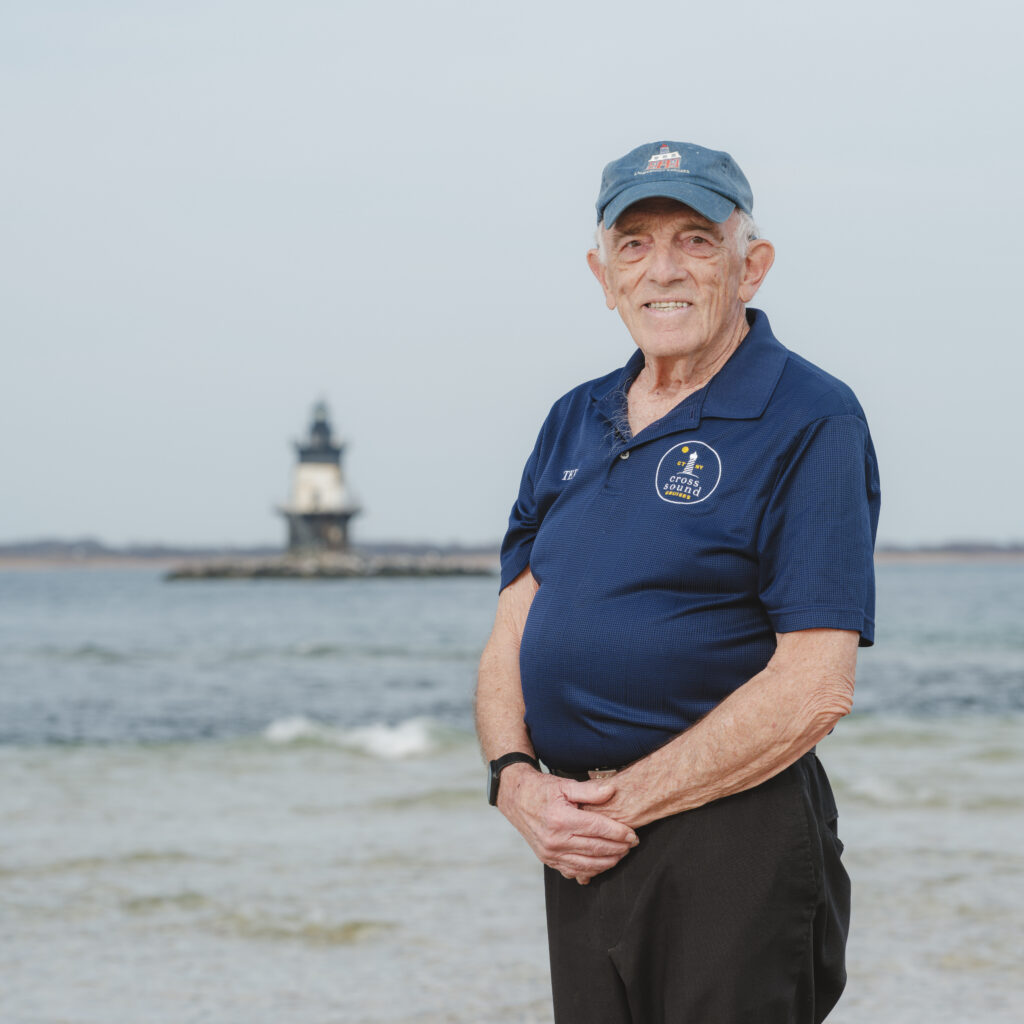
“I have always had a fascination with lighthouses,” says Webb. A past president and chairman of the board of the East End Seaport Museum and Marine Foundation, Webb worked with the Cross Sound Ferry to develop the idea for the yearly lighthouse cruise for members. “It was one of our biggest fundraisers,” he says. When ferry officials heard Webb telling rapt passengers about the history of each lighthouse, he was offered a job as a tour guide.
“I’ve done it for 15 or 16 years,” Webb says. “We visit all the Southold Town offshore lighthouses … they go back to our early American history; I think that’s what people enjoy. And unless you are a boater, you can’t get close and see them and hear about their history. [With the tours] passengers can get up close and personal.”
Webb’s ancestry in Greenport goes back to the 1700s and he grew up spending summers in Orient, where he tooled around in his Lightning class sailboat and visited a couple of the lighthouses — “not always legally,” he recalls. He and his wife moved to Orient permanently in 2002 and he has done extensive volunteer work in the area, from serving as commander of the Coast Guard Auxiliary in Southold to working with the Oysterponds Historical Society. Currently, he’s chairman of Peconic Landing’s Brecknock Hall Foundation. Webb’s notes, used while narrating the lighthouse cruises, serve as the basis for the Cross Sound Ferry’s Lighthouse Cruise guidebooks.
“I love the history of the lighthouses and the people that I meet; many share a love of lighthouses with me, they ask a lot of questions,” says Webb. “If you like being on the water and hearing about American history, this is the trip for you.”
How many of Southold Town’s eight lighthouses have you seen? A primer follows, but grab your tickets for a cruise this season to see them in person.
Latimer Reef Lighthouse
Situated about a mile north of Fishers Island, Latimer Reef is purportedly named after James Latemore, who spied on a British fleet anchored in Fishers Island Sound from his skiff during the Revolutionary War. He was discovered and chased by the British, ran his boat aground on the reef and captured. He was hung at sunrise the following day and found a watery grave in the Sound. (Folk has her doubts about the accuracy of this story but it’s a great tale nonetheless.)
First marked by a private lightship anchored near the reef starting in 1837, the “spark plug” type lighthouse was built in 1884 — a prefabricated, 49-foot-tall cast iron tower with a concrete-filled foundation. Cast iron lighthouses were bitterly cold in winter and terribly hot in summer, making them quite uncomfortable for their keepers. The Latimer Reef lighthouse was auctioned off by the Coast Guard in 2008 and bought by private bidder Scott Phillips for $225,000; Phillips founded a short-lived hedge fund named Latimer Light Capital after the beacon.
Race Rock Lighthouse
Set on Race Rock Reef about three-quarters of a mile southwest of Fishers Island, this Gothic Revival style lighthouse was built between 1871 and 1878 and marks a dangerous location where scores of ships have foundered and wrecked. The original beacon was mounted on an iron shaft sunk four feet into a huge boulder about 200 feet in diameter, which rested on a rocky ledge.
A massive engineering feat, the plan for the building of the lighthouse was a granite pier topped by an octagonal two-story keeper’s residence and a lantern, which was hoped to resist the destructive power of storm waves and pack ice.
The concrete foundation was constructed on a ledge below the surface of the water and took seven years to complete. The reef and the lighthouse are rumored to be haunted, with reports of ghostly voices, sightings of a shadowy figure in the tower and trails of wet footprints, even though the structure has no running water; it was featured on the Ghost Hunters television show in 2004. Race Rock was added to the National Register of Historic Places in 2005 and turned over to the New London Maritime Society in 2013.
Little Gull Island Lighthouse
The first light on Little Gull Island was a tower lit in 1806. It marked the treacherous spot known as the Race, where Long Island Sound and Block Island Sound meet and currents can exceed five knots. The keeper and his family lived in very isolated, foggy conditions on the island’s acre of land. During the War of 1812, the British landed here and forced the removal of the lamps and reflectors, putting the station out of service until the conflict ended.
The present lighthouse was built in 1868, with a three-story keeper’s house and an 81-foot granite tower that still stands on the island today. The hurricane of 1938 destroyed many of the island’s outbuildings and a fire in 1944 damaged the keeper’s house and the tower.
The lighthouse’s Fresnel lens was removed in 1995 and put on display at the East End Seaport Museum. In 2012, the lighthouse was sold at auction to Fred Plumb, a Connecticut businessman who had hoped to reopen the lighthouse to the public but passed away in 2017. The lighthouse is still privately owned and the island remains one of the very few grey seal rookeries on the East Coast.
North Dumpling Island Lighthouse
Located on North Dumpling Island in Fishers Island Sound, this lighthouse with a 25-foot tower is constructed of red brick and was built and lit in 1849. The island has only had five owners since 1639; the Winthrop family sold the property to the U.S. government in 1847 for $600 for the purpose of constructing a lighthouse. During Prohibition, the lighthouse keeper came under suspicion of aiding rum runners by signaling boats and bootleggers on the mainland and on Fishers Island, but no hard evidence of this was found. The two-acre island is currently owned by Dean Kamen, inventor of the Segway, who refers to the island as the “Kingdom of North Dumpling” and has established a Constitution, a currency, a flag, a national anthem and a one-boat navy.
Horton Point Lighthouse
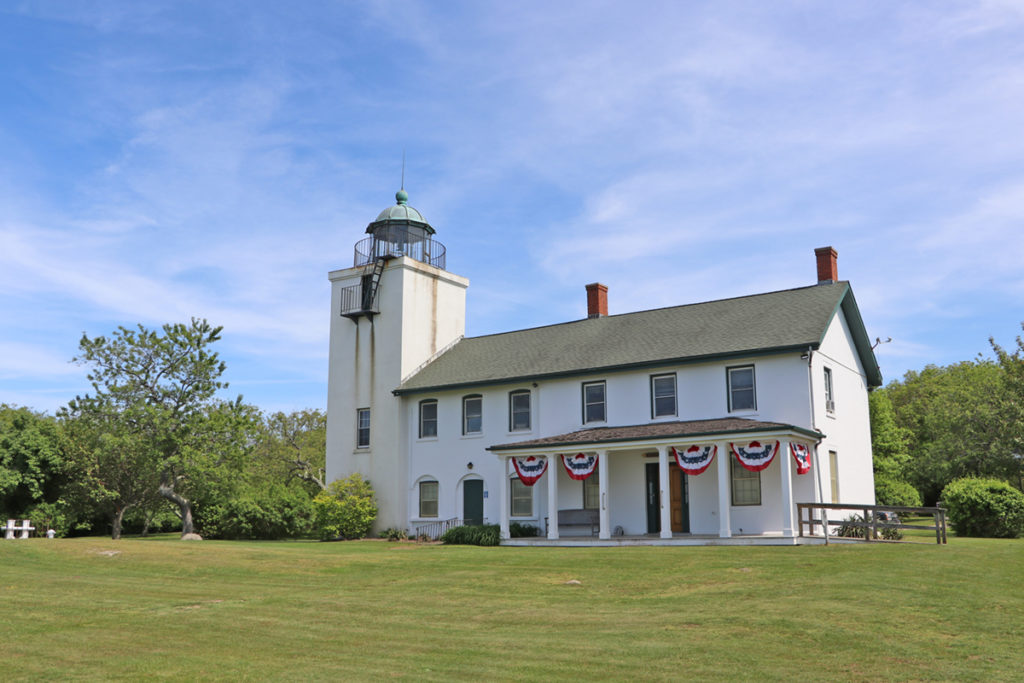
This lighthouse sits on a bluff overlooking Long Island Sound. Originally commissioned by George Washington in 1790, it wasn’t funded until 1854, and construction began in 1855 of a 55-foot-tall tower and a separate two-story keeper’s residence.
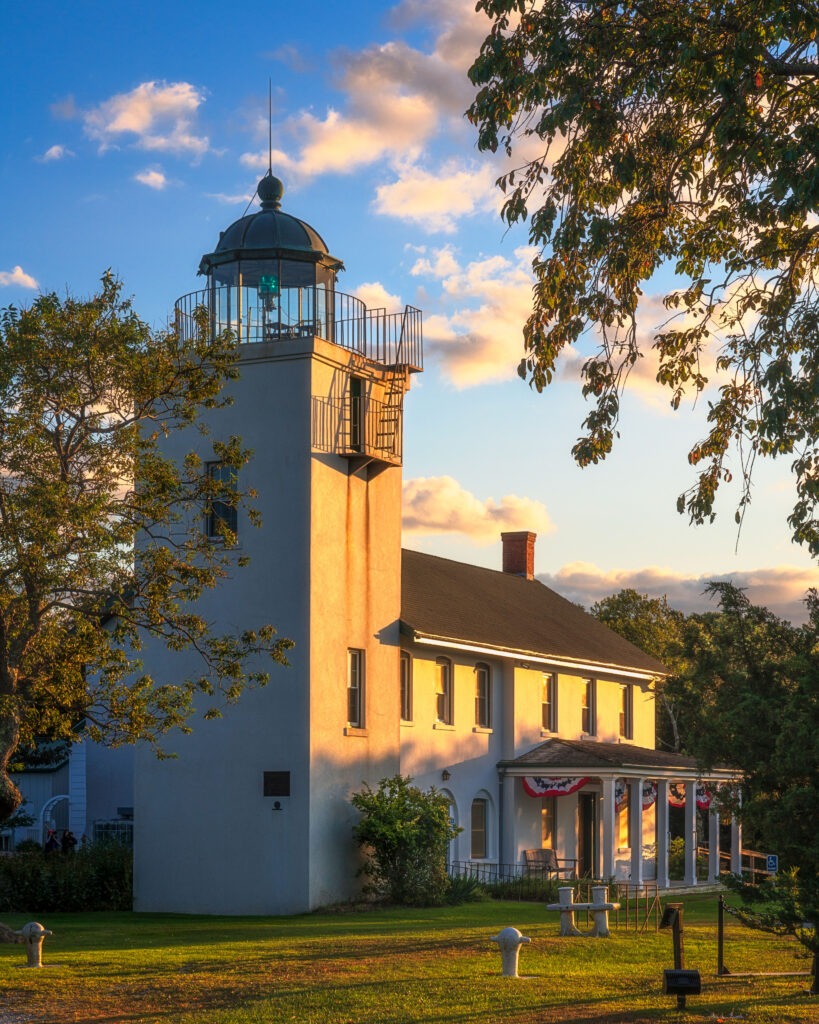
Stella Prince, the daughter of keeper George Prince, was enlisted to keep the light burning when her father was dismissed and the assistant keeper was hurt in an accident (read her story in The Lady Lighthouse Keeper, a novel by North Fork resident Mary Korpi, a docent at the Southold Historical Museum).
The station was decommissioned in 1933 and leased to the Southold Park District and later to Southold Town. Abandoned and almost razed, it was saved and restored and is now a nautical museum open to the public and maintained by the Southold Parks District and the Southold Historical Museum.
Plum Island Lighthouse
Situated on the west end of Plum Island, the first lighthouse on this spot was an octagonal stone tower built in 1827, equipped with 10 whale oil lamps with reflectors and a keeper’s residence; a 55-foot granite structure replaced the deteriorating tower in 1869 with a two-story residence with a cast-iron tower attached to the roof. The light guided mariners through the strong tides of the Plum Gut channel between Plum Island and Orient Point.
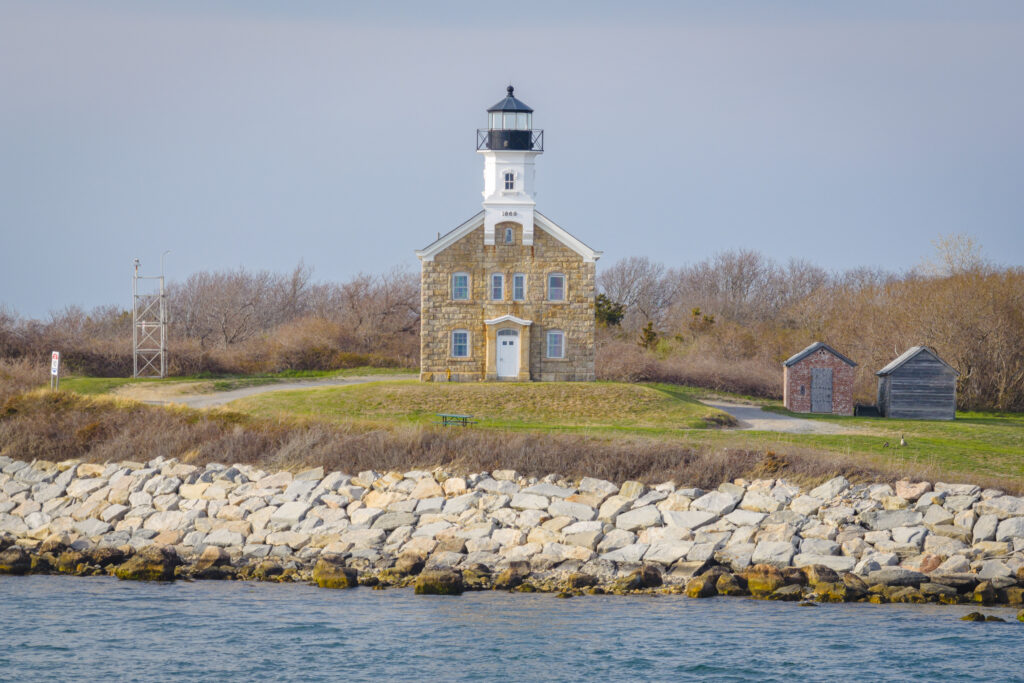
The light was decommissioned in 1970 and turned over to the U.S. Department of Agriculture, which operated the Plum Island Animal Disease Center on the island.
In 2000, East End Lighthouses, helmed by local historian Merlon E. Wiggin, organized to restore the lighthouse and shore up the bank in front of the station. In 2004, 15,000 tons of rock from the dismantled breakwater in Sag Harbor were brought over by barge and placed at the bottom of the hill below the lighthouse to prevent erosion.
Long Beach Bar Lighthouse
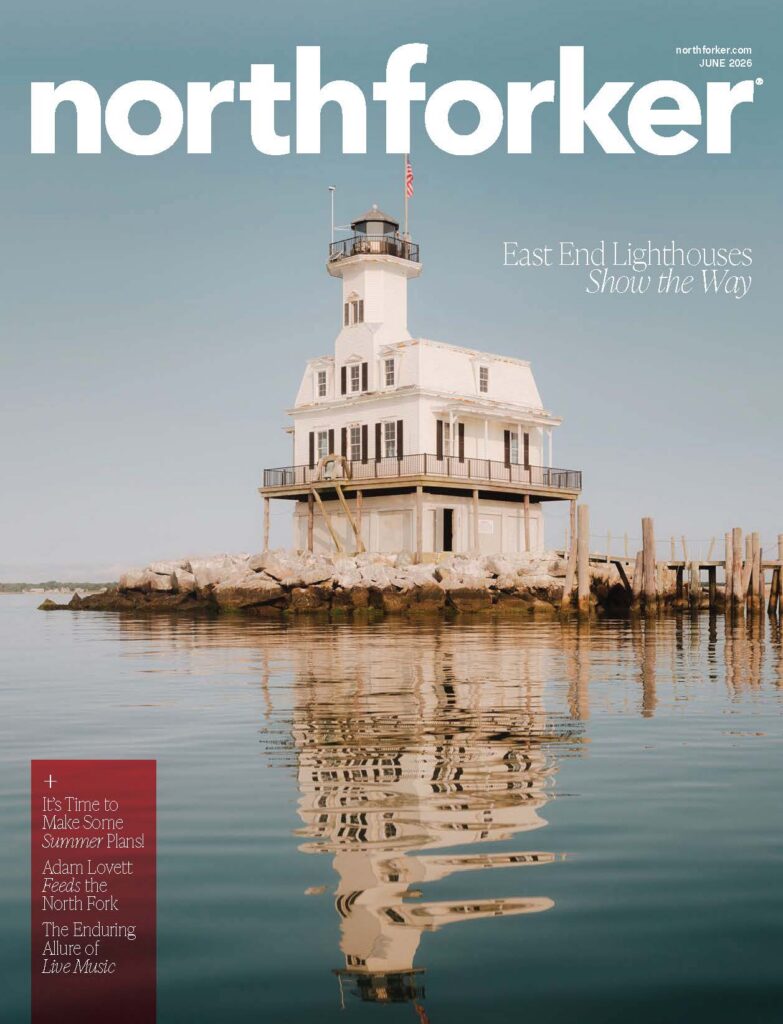
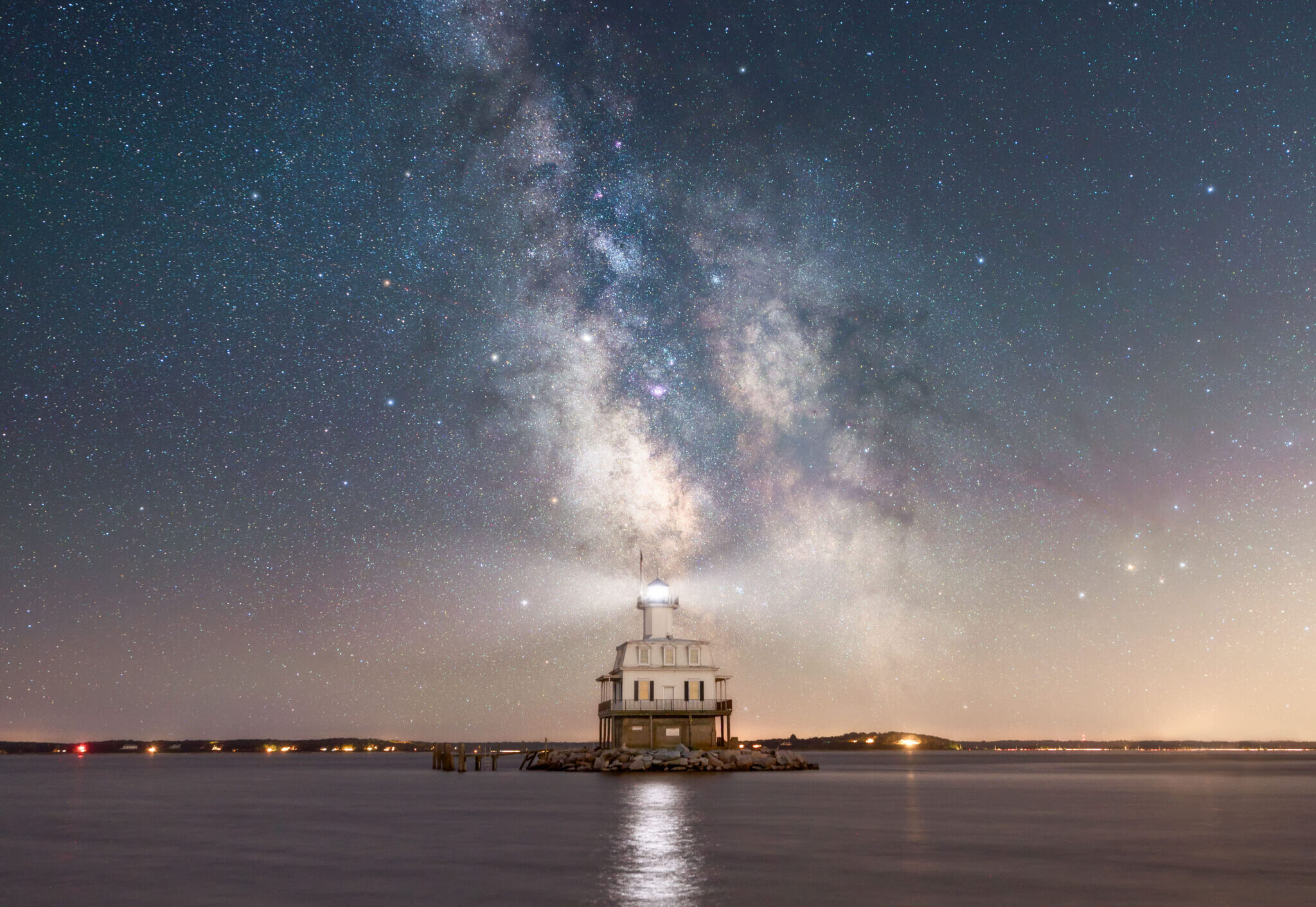
Called “Bug Light” by locals, this distinctive Victorian style lighthouse that is visible from land was originally built in 1870 and lit in 1871. According to Wiggin, “The original structure was on screw piles, open underneath, which led to its colloquial nickname of Bug Light because at high tide it looked like a giant water bug.”
The station’s pilings were often damaged by ice. A reinforced concrete foundation was installed in 1926, along with a new bathroom with a flushing toilet. The station was decommissioned in 1948 and a local group won it with a bid of $1,710. On July 4, 1963, arsonists set fire to the structure, destroying it.


Bug Light was lit in 1871, damaged by ice and fire, and rebuilt in 1990 at the Greenport Yacht and Shipbuilding Yard. (Photo credit: Jeremy Garretson)
The East End Seaport Museum and Marine Foundation raised funds for a replica of the lighthouse. This was built in the Greenport Yacht and Shipbuilding yard and slid down its marine railway in 1990, with a Navy band playing and a 21-gun salute. Three separate sections were loaded onto barges, towed to the site and assembled by crane.
Today, EESMMF is raising funds to restore Bug Light’s foundation and construct a safe, accessible dock. When work is completed, the Foundation will resume its summer lighthouse cruises to the lighthouse.
Orient Point Lighthouse
While markers have been placed in this location since 1855, the lighthouse, known as the Coffee Pot, was built in 1898 to guide mariners through the treacherous Plum Gut. It marks the eastern tip of the North Fork and is of a design known as a spark plug lighthouse, demonstrating a simple, utilitarian style. Situated on Oyster Pond Reef, it has a 21-foot base made of cast iron filled with concrete, is 64 feet high with three levels of living quarters, and has a five-degree tilt, due to either a shifting foundation or the uneven weight of heavy plates applied to repair cracks. Over the years, many tons of rock (known as riprap) were placed around the foundation to help the lighthouse withstand ice and winter storms.
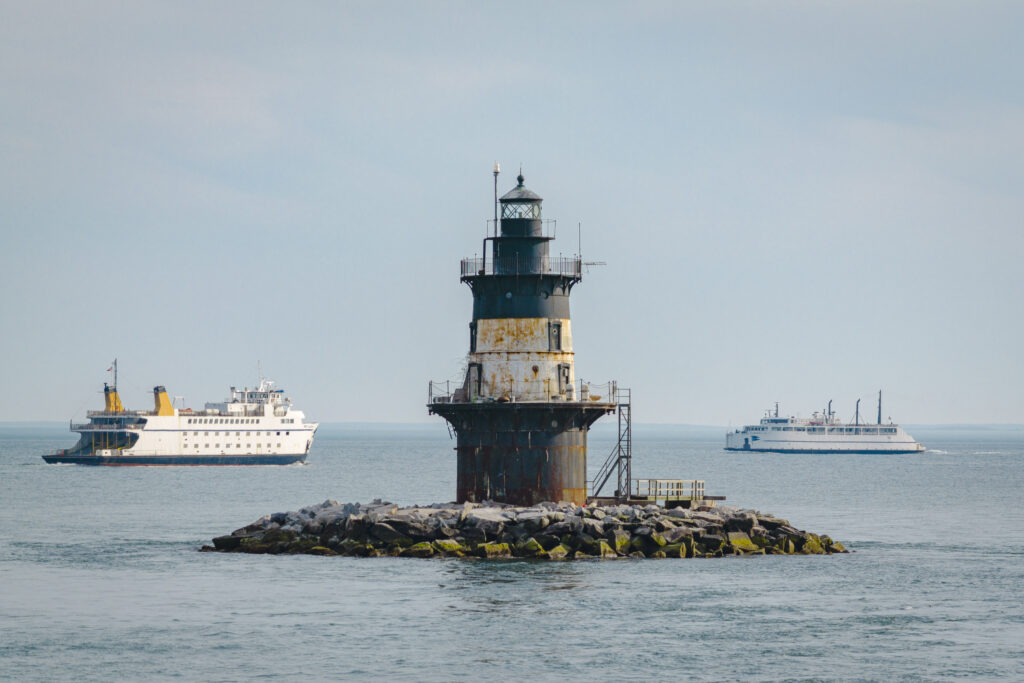
In 2011 the Orient Point Lighthouse was declared excess to the needs of the Coast Guard and auctioned off the next year. It’s owned by Randy Polumbo, an artist and New York City construction company owner who won it with a bid of $252,000. The lighthouse is closed to the public and has served as an artists’ residency the past few years.
To read more about Southold Town’s lighthouses, check these sources:
<< The Lighthouses of Southold Town, a brochure by Merlon E. Wiggin
<< Cross Sound Ferry’s Long Island Lights Cruise Guide: Stop by Stop
<< Kraig Anderson’s website lighthousefriends.com