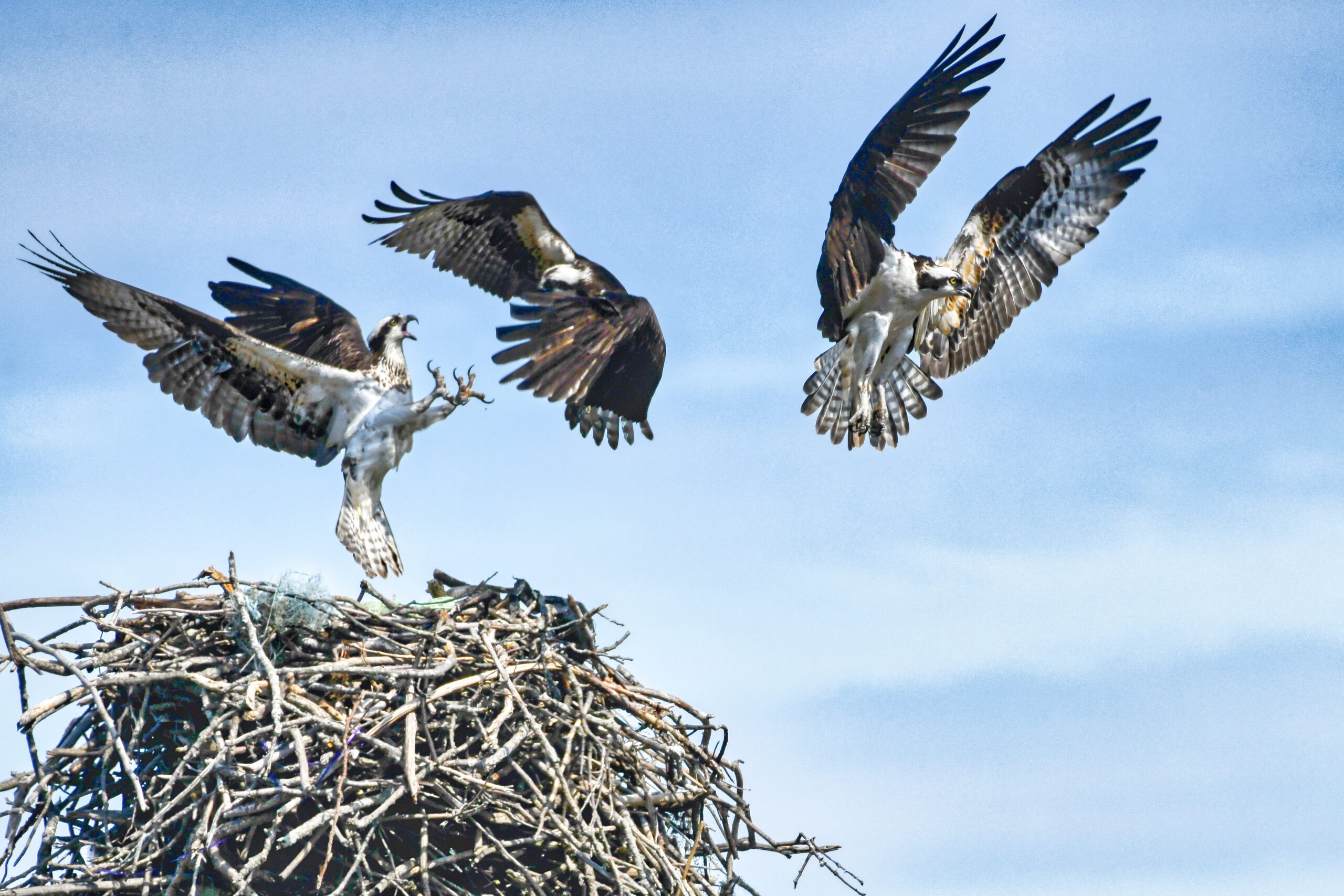
Ospreys are everywhere on eastern Long Island — circling the sky, feeding their young in nests on waterside platforms (and occasionally atop electrical poles in store parking lots) or diving into the bay to grab a seafood snack. The birds are a constant presence on the island from March to September, after which they migrate to a more tropical climate.
But the osprey is more than just a fish-hunting raptor — it’s a barometer of environmental health and a symbol of adaptability. Once in danger of going extinct, the osprey has mounted one of the strongest comebacks in natural history thanks to ongoing conservation efforts.
FOLLOWING THE FISH HAWK
Sometimes called fish hawks, sea hawks or fish eagles, the distinctive brown and white bird is found on every continent except Antarctica. Ospreys have four-to-six-foot wingspans, can fly up to 50 mph when diving for fish and live up to 30 years.
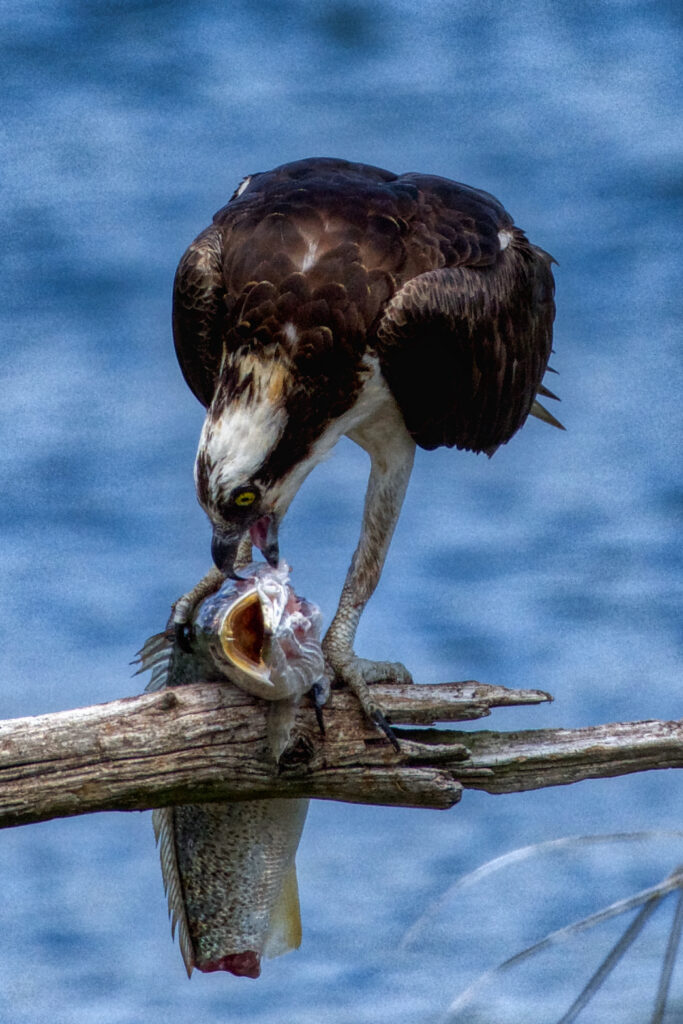
Formidable fish hunters, they nest near shallow waters, from coastal inlets and marshes to inland lakes and rivers. They possess double-jointed toes with spiny pads to help them grip slippery fish, nostrils that close to keep water out when they dive and oily plumage to prevent waterlogged feathers. According to birdsoftheworld.com, ospreys are the only raptors that plunge-dive to catch live fish as their main prey, and it’s not uncommon to see one flying overhead gripping a fish destined for its family’s dinner.
A LOCAL MASCOT
The osprey has become a beloved and tenacious regional symbol to locals of all stripes. The North Fork Ospreys, one of the teams in the Hamptons Collegiate Baseball League, play at Jean Cochran Park in Peconic during the summer, where Morning Call, a giant bronze sculpture of an osprey, perches on a beam from one of the World Trade Center towers.
Then there’s Osprey’s Dominion, the 90-acre Peconic vineyard and winery that’s been around since the early 1980s. Tasting room manager Peter Carey notes that “[owners] Bud Koehler and Bill Tyree had an appreciation for the osprey … we have many flying around our property, which is how the name came to be, as this is their ‘dominion.’ The pair that make the vineyard their home return every year in March and an image of the bird is on every Osprey’s Dominion bottle of wine.”
And Cutchogue East Elementary, Oysterponds Elementary and Mattituck-Cutchogue Jr.-Sr. High School all count the osprey as mascots, with the giant bird making costumed human appearances at pep rallies and sporting events.
“From what I understand, it’s accurate to say the osprey has become the school’s unofficial mascot,” says Patrick K. Burke, principal of Mattituck-Cutchogue Jr.-Sr. High School. “Their focus, adaptability and skill make them experts in their field, much like the students and staff at Mattituck.”
Last year, Southold Free Library unveiled Olive the Osprey, created by local illustrator and Southold High School grad Harry Antonucci, as their cartoon mascot. Olive can be seen on stickers and t-shirts as a reminder to folks to “fly in” to the library for information and assistance.
With all the fanfare, it’s hard to believe ospreys were practically extinct just a few decades ago.
THE BIG COMEBACK
The primary reason for the decline of ospreys was use of the pesticide DDT in area agricultural practices, which came into practice during World War II as a way to control insect-borne diseases like malaria, and later grew popular in international farming as a way to control pests. Of course, pesticides that control one thing inevitably affect another, and in this instance DDT caused eggshell thinning and precipitously reduced ospreys’ reproductive output. According to the New York State Department of Environmental Conservation, “The breeding population declined from an estimated 1,000 active nests in the 1940s between New York City and Boston to an estimated 150 nests in 1969.”
DDT was banned in New York State in 1971 and by the rest of the country in 1972 and the osprey population slowly began to increase in numbers. Its status was downgraded from “endangered” to “threatened” in 1983, and from “threatened” to “special concern” in 1999. Today, ospreys thrive across the country despite dangers from toxic chemicals, plastics, fishing line and loss of habitat.
“Ospreys are also great indicators of local water quality because their lives depend so much on the health of the waterways they live on,” says Jennifer Skilbred, Group for the East End’s assistant director of environmental education. “For example, if a local watershed is suffering from nitrogen pollution, which is a well-documented issue in some of our local waters, it can lead to lower oxygen levels, less clear water, harmful algal blooms and, ultimately, fewer fish for ospreys and their chicks.”
THE MOST-MONITORED BIRD
New York State Department of Environmental Conservation, which monitors the status of ospreys in New York State, notes that the bird “is probably the longest-studied and monitored raptor in New York.” Group for the East End, based in Southold and Bridgehampton, conducts osprey monitoring every three years and shares their data with the state.
The news is good. In the Group’s latest survey, completed in 2025, staff, expert birders and volunteers visited 587 osprey nests across the East End, documenting 385 active nesting pairs which produced 386 fledglings. Southold accounts for 138 active nests, while Shelter Island has 50 and Riverhead has 18 (and that’s not including Shelter Island’s Mashomack Preserve, Southold’s Robins Island, Plum Island or Fishers Island).
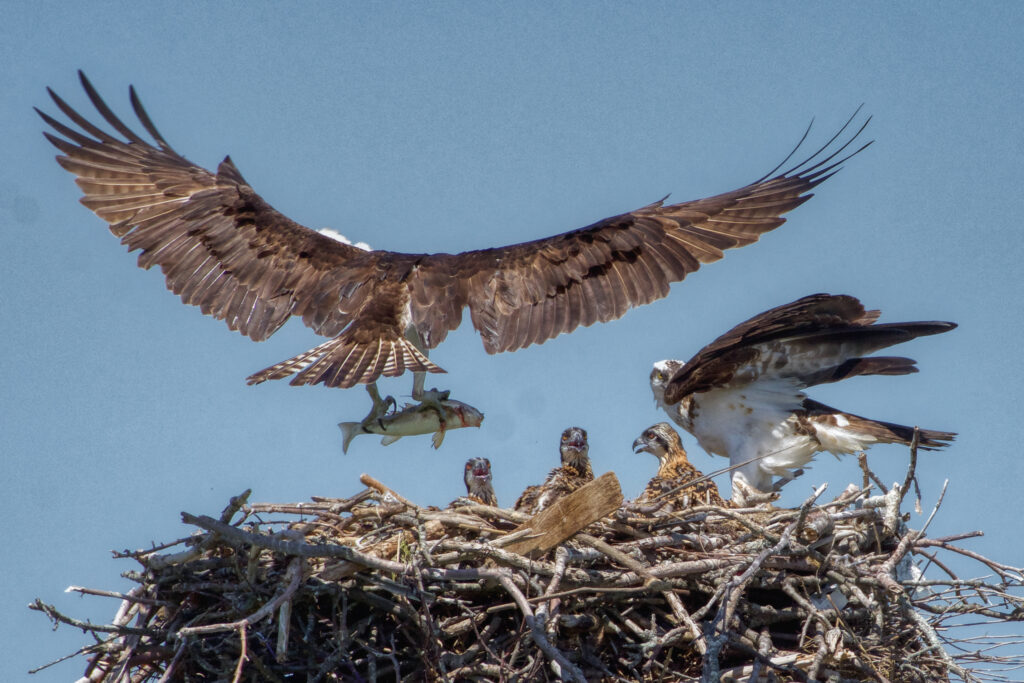
Between monitoring sessions, Group for the East End focuses on hazard and conflict mitigation, working with PSEG Long Island to discourage ospreys from nesting on electrified utility poles, which can be dangerous. The former Long Island Lighting Company (now PSEG) began installing osprey nesting platforms as far back as 1978 both to encourage population growth and discourage them from nesting on utility poles, a collaborative effort with the Department of Environmental Conservation and the Nature Conservancy. Today, PSEG regularly installs v-guards as deterrents, something you can see at the top of many utility poles around town.
The Group provides advice on installing or repairing nesting platforms, but tread carefully when dealing with the nests themselves as they are protected by federal and state laws from disturbance during the breeding season, March 15 to Sept. 1.
WATCHING THE SHOW
One of the reasons people love ospreys is because they bring the drama. Watching them as they build a nest, hatch their young, feed them and (eventually) kick them out of the nest to stand on their own is a real-life show even better than streaming the latest Netflix or Amazon Prime drama.
Many local folks track the dates that ospreys return for the season on their calendars. Toby Altman, a longtime Mattituck resident, has been monitoring their homecoming to Mattituck Inlet for five years. Altman notes the birds returned on March 27 two years ago and on March 17 last year. This year, she spotted a lone osprey on March 16.
“I’m not a birder,” says Altman, “but it’s all about awareness. After many years you start to see the nuances [in observing them].” In that regard, ospreys are a very welcome sign of spring in these parts.
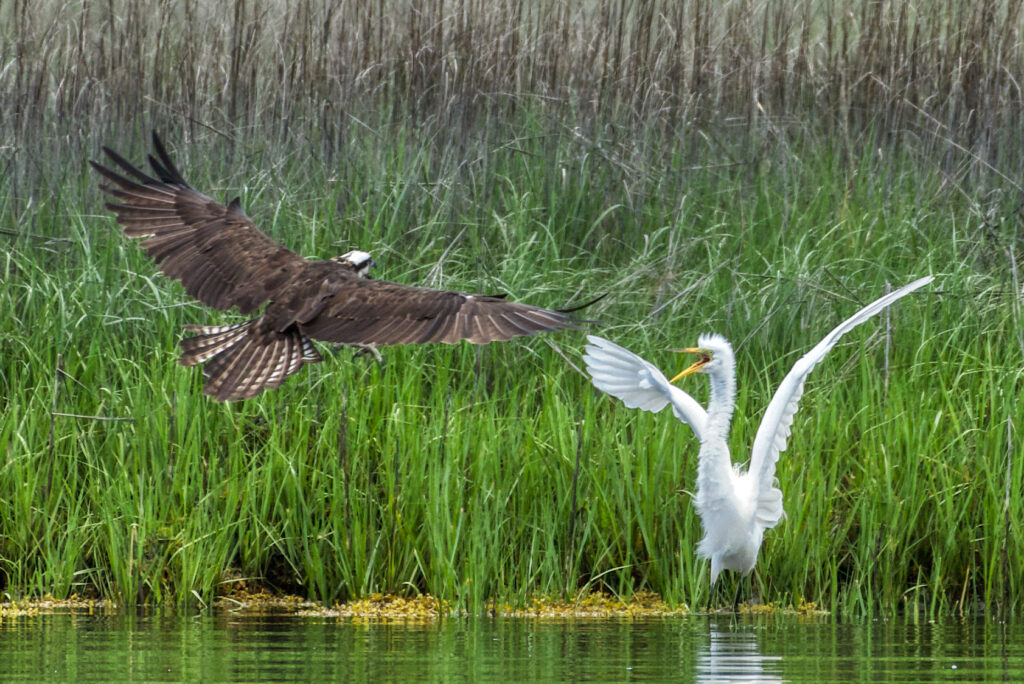
Photographer and bird watcher Dietmar Riccomini often documents confrontations between ospreys and other creatures who get too close.
“Geese don’t usually go into an osprey’s nest — they like to stay in the water or on land.” says Riccomini. “Egrets usually feed near the shoreline without any problems, but when the ospreys lay their eggs and have their young, anything or anyone within 25 feet is quickly notified by the male osprey that they’re not welcome. During that time the ospreys are extremely territorial and it makes for some great pictures.”
Endangered shorebird specialist and wildlife rehabilitator Jen Murray of Turtleback Conservation Center observes ospreys regularly. Despite their propensity to nest on poles, ospreys will build a home anywhere that affords a sturdy, safe space. “Ground nesting is not uncommon where the population is strong and suitable nesting locations are scarce,” she says. “Some nest atop glacial erratic boulders that stand tall above the high-tide line.”
Aside from where nests are built, one of Murray’s favorite topics is what ospreys use to construct their nests. She has seen odd items like baseball cap visors, children’s sand toys and whole crab traps.
“The coolest osprey nest I have ever observed was a ground nest atop a driftwood log. It had the head and spine of a great black-backed gull woven into the sticks. It was also during a season when this species of gull was nesting nearby and there was a lot of feuding between the two nesting species,” says Murray. “I had anthropomorphized and figured the skeleton of the gull woven into the nest was a warning. In actuality, osprey will add anything they feel increases the nest’s structural integrity.”
HOW YOU CAN HELP
Here are a few key tips from Murray to keep ospreys happy and healthy:
> Participate in beach cleanups to remove marine debris, particularly balloon strings, fishing line— anything an osprey can get tangled in—before males start refurbishing their nests in March. Fatal entanglements are a preventable, human-caused threat.
> Give nesting ospreys space. Ospreys are naturally high-strung raptors that are easily flushed from their nests during incubation and chick-rearing. Photographing an osprey that is calling out while hovering over the nest means you are too close!
> Leave tree snags when they do not threaten people or property along a shoreline. Ospreys prefer to nest in dead tree snags, which are ecologically important.
> If you see a pair of ospreys building a nest on a utility pole without a protective platform installed by PSEG, call 1-800-490-0075 immediately with the street and utility pole number (usually found on a metal tag on the pole) to avoid the osprey experiencing electrocution.
> As you watch ospreys throughout the season, consider volunteering at a local environmental organization or bringing the kids to a Return of the Osprey event in the spring (Turtleback Conservation Center has one, as do some of our local Parks Districts). It is our continued stewardship that will enable the ospreys to keep thriving.