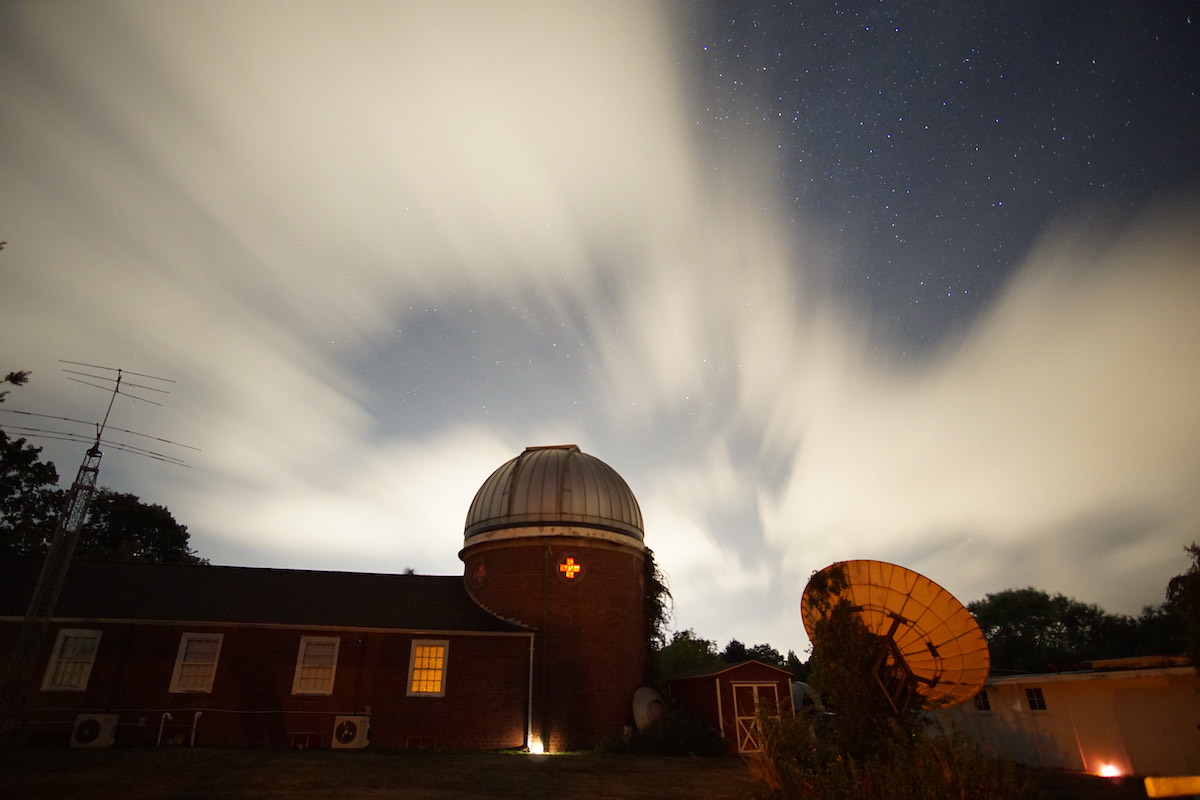
Southold’s Custer Institute & Observatory is holding its first ever Messier Marathon, a deep-sky challenge attempting to locate all 110 astronomical objects documented in Messier’s Catalog in one night.
While many of these objects are viewable in the heavens throughout the year, due to timing of the sun’s path, March is the only time all 110 may be observed at once, according to Custer’s registration page for the event.
Messier’s Catalog, created in the 18th century by French astronomer Charles Messier and his assistant, Pierre Méchain, features many of the deep-sky objects like nebulae, star clusters and far-away galaxies that can be seen from the Northern Hemisphere.
On Saturday, March 21, from sunset to sunrise, participants can use the observatory’s prime location and open skies to attempt to view all 110 objects in one night.
Farhan Ali, Custer board member and outreach director, organized the overnight event.
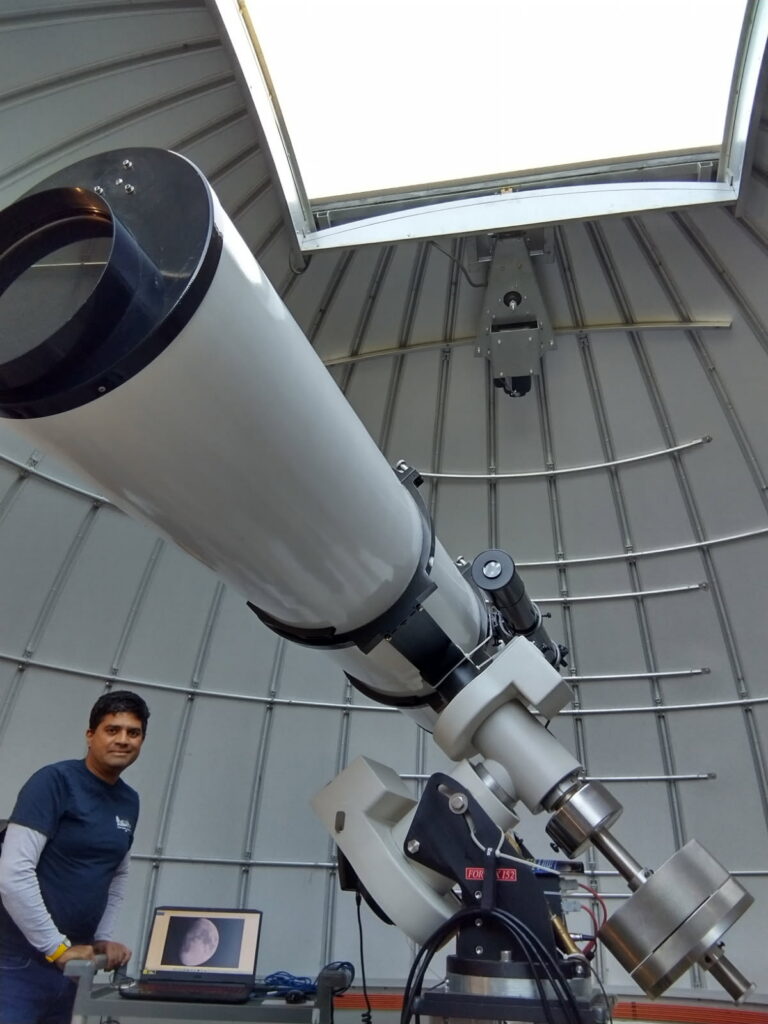
Custer Institute and Observatory board member and outreach director Farhan Ali organized the upcoming stargazing event. (Photo Courtesy of Farhan Ali)
“The idea grew from two powerful inspirations,” he wrote in an email to The Suffolk Times. “First, tackling the full Messier Marathon is a true milestone for any amateur astronomer … It’s one of those experiences that observers talk about for years.
“Second, despite being one of Long Island’s oldest and most cherished observatories, Custer had never attempted an all-night Messier Marathon,” Ali continued. “It felt like the perfect moment to change that.”
Registrants can look forward to observing celestial bodies such as Messier 3, a globular cluster containing over 500,000 stars; Messier 66, part of the Leo Triplet of galaxies; elliptical galaxy Messier 87; and Ali’s personal favorite, Messier 81 — what he describes as a “magnificent spiral galaxy” that is “nestled in the constellation Ursa Major.”
While possible, observing every object in the catalog in one night is an “extraordinary” and “ambitious challenge that requires perfect conditions, expert planning and a bit of luck,” according to Ali. He recommends the more realistic benchmark of viewing 70 to 80 deep-space objects — still a breathtaking and boast-worthy achievement.
To tackle such a feat, participants are encouraged to dress appropriately for a chilly March evening, and bring a blanket, their own telescope and a red flashlight or headlight.
It’s also recommended that attendees have some astronomical knowledge. Despite this suggested prerequisite, no one will be left completely in the dark.
“Many of our experienced docents from the Custer Observatory team will be leading and supporting the Messier Marathon,” Ali said. “Out on the grass, additional staff will have their personal telescopes trained on specific targets to help everyone stay oriented … My colleagues and I will also be illuminating key areas to help participants find the general direction of the objects we’re targeting.”
In anticipation of brisk evening air, Ali said the observatory building will be open throughout the night for attendees to warm up in. Guests can also visit the institute’s “Cosmic Cantina” to indulge in a “complimentary coffee and a selection of healthy, energizing snacks” to keep their curiosity fueled throughout the night.
Observatory staff will also provide a fun honor to commemorate the marathon that parallels previous astronomical tradition. According to NASA, the Astronomical League — “an organization for amateur astronomers”— awards a certificate to anyone who is able to locate all 110 catalog entries, thus designating them as part of the Messier Club. Custer Institute & Observatory will pay homage to the league’s distinction by handing out their own certificates to participants at their March 21 marathon.
These differ from the Astronomical League’s Messier certificate, which requires “detailed documentation” for each object, said Ali, “something that simply can’t be achieved in one night.” Instead, Custer’s marathon is more focused on the thrill of discovery rather than the achievement of it. The institute’s certificates are a “fun, motivating way to celebrate the challenge … and encourage observers to continue their journey toward the Astronomical League’s prestigious recognition.”
Those who wish to participate are encouraged to register early at custerobservatory.org. For non-members, there is a $10 admission fee; for Custer members, admission is free. As of Wednesday, March 11, around 40 people had already signed up, according to Ali.
Poor weather and cloud cover greater than 40% will cancel the event. In that event, pre-registered participants will be informed via email, Custer will update their website with an announcement, and full refunds will be issued.
Ali remains excited to bring this event to the North Fork.
“Dedicating an entire night to chasing every one of these iconic objects not only honors the long history of observational astronomy but also brings our community together under a shared sky,” he said in his email. “In many ways, this event is our way of saying, ‘Let’s celebrate the night, the stars and the legacy of exploration — together, from dusk till dawn.’”