To walk into Freezer #2 at Long Island Ice & Fuel is to step away from the streets of downtown Riverhead and into the presence of a glacier. The temperature is somewhere between 17- and 25-degrees Fahrenheit and there is an astounding amount of ice stacked in the cavernous room. This 125-year-old company can store two million pounds of bagged ice at a time. Freezer Number Two holds about a day’s supply during the busy season.
For the modern-day Conklin family, owners of Long Island Ice & Fuel on West Main Street, ice isn’t merely a commodity in a cooler: it’s a calling that goes way back. In 1880, William Sweezy began to harvest ice from the Forge River on the south side near Brookhaven, pack it in sawdust and hay and deliver it in horsedrawn trucks.
Everything has changed in the world of ice during the years the Sweezy/Conklin family has been in the business, including how it is made, how it is used and who buys it, but the family has adapted to changing demographics and technologies. The only constants: the ice is made at the same Riverhead plant, with the same local water, by the same family.
A Family That Heats Up Over Ice
The sixth generation of owners and operators consists of Megan Conklin, who describes herself as “an ice nerd,” her brother Josh Conklin and their cousin Andrew Conklin, a reserved man who becomes loquacious when it comes to making ice. They are happy to show off, to anyone willing to enter the frozen rooms of their factory, how they make better ice more efficiently than companies three times their size. “The Ice Plant,” as the factory is known to the family, runs 24/7 and has a smaller footprint than the average mega-mansion. One recent afternoon in 17°F Freezer #2, Andrew excitedly points to the ample inventory necessary to supply Yankee Stadium (one of their clients) with enough ice for a day game — and he’s not even wearing gloves.
So acclimated are the cousins to the cold, it’s as if over generations the family has evolved to have cold-hardy genes that keep them from chattering and shivering like mere mortals. But decades of honing a craft and a business will do that to you. Founder William Sweezy passed the business he established to his daughter Jennie and her husband, Albert Willis Conklin, known as “A.W.” In addition to running the company, Conklin served as president of Suffolk County National Bank and he and his wife were prominent in Riverhead society.
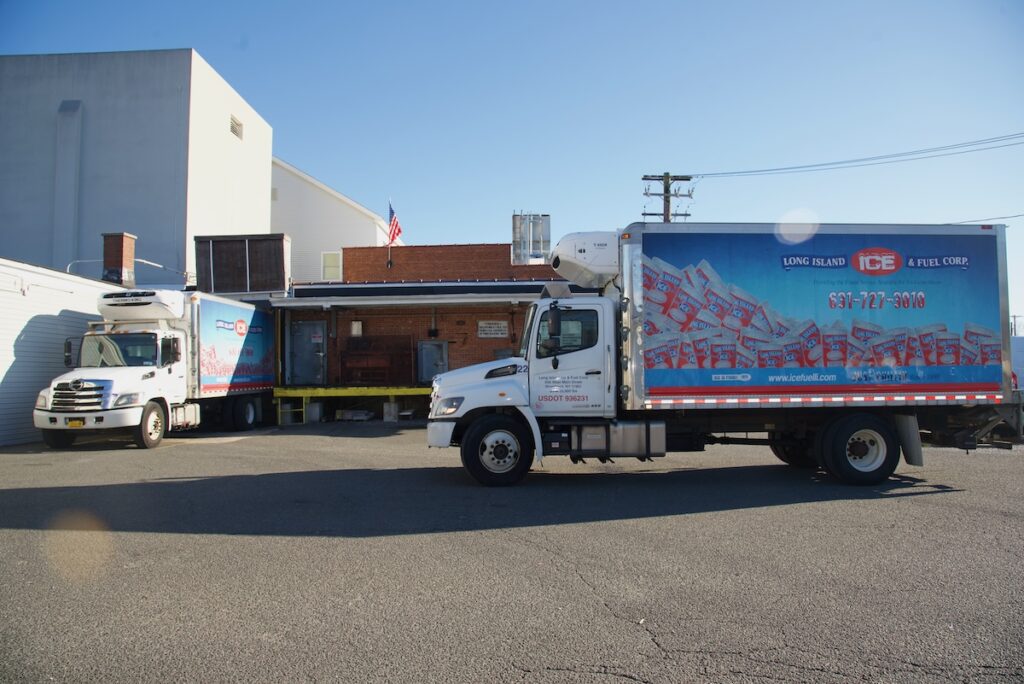
Around the turn of the 20th century, mechanical ice-making started to take the place of cutting blocks of ice from naturally frozen freshwater, and A.W. increased the factory’s capacity from five tons a day in 1900 to 40 tons a day in 1915. Under his leadership, the business continued to grow until after World War II, when the block-ice business suffered a steep decline as homeowners began to trade ice boxes for refrigerators.
The company’s third generation, led by A.W.’s son Duane “Skip” Conklin, coincided with the decline in fortune. Under Duane, the business began selling fuel in addition to ice but did not invest in modernizing its ice equipment. Packaged ice cubes started to replace block ice and, in 1972, Duane sold what was left of the company to his son William Conklin, the fourth-generation owner.
“The place was a shambles,” says Chris Conklin, who is the company’s fifth-generation co-owner along with his brother Kyle. “Our grandfather did not invest in the company. He sold the business to our dad with 50-year-old equipment.”
From 1972 until his death at 87 in 2019, William “Chilly” Conklin took Long Island Ice & Fuel to new levels of productivity and efficiency.
“There was a lot of renovation,” says Kyle. “Every year he would add.” As Long Island’s economy grew more robust, and the company’s ability to deliver to restaurants and businesses moved farther west, Long Island Ice & Fuel could barely keep up with demand.
“My father had a really good relationship with a mechanical refrigeration engineer,” says Kyle. “It was expensive at the time, but we built capacity despite very limited space. The way the space is set up and the way we use power is very efficient.”
Innovation From Adversity
When Hurricane Sandy hit in October 2012, it acted as a stress test for the enterprise, which had successfully transitioned from block ice to packaged cubes, and from home delivery to business deliveries in the 20th century. October isn’t usually a peak time for ice, but when Sandy hit, demand was two to three times higher than on the busiest summer days — and while the plant only lost power for a couple of days, there was no way to make enough ice for the thousands of Long Island households that desperately needed it.
“I don’t really like the memory of that time,” says Kyle. “It was unsustainable. Ice would not even go in the trailer. It went off the truck, on the sidewalk, into people’s cars. We had no break.”
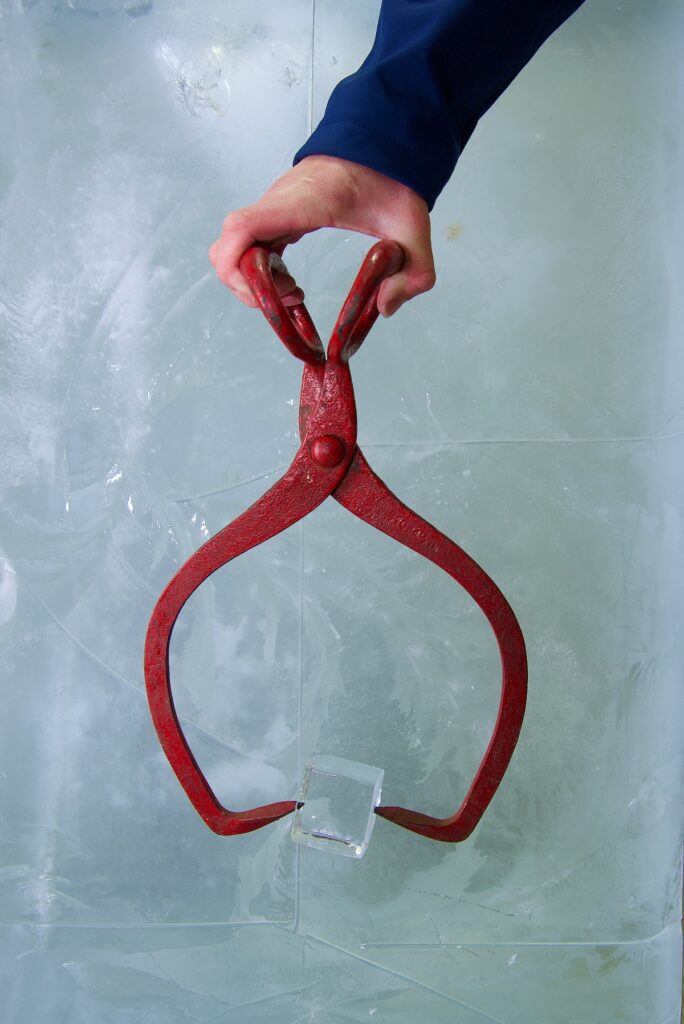
In the wake of Sandy, the company invested in new equipment to increase capacity and efficiency, including three icemakers from Vogt, a Louisville, Ken.,-based manufacturer, that create the mini-donut-shaped ice cubes that are now the industry standard for bagged ice. The plant also has a Clinebell, mechanical refrigeration equipment that takes three days to produce a 300-pound block of super-clear “gourmet ice” that can be sculpted into diamonds, honeycombs, Collins cubes (think sticks of butter) and two sizes of crystal spheres. Ice sculptures and custom shapes and stamps for company events and weddings are also made with the Clinebell.
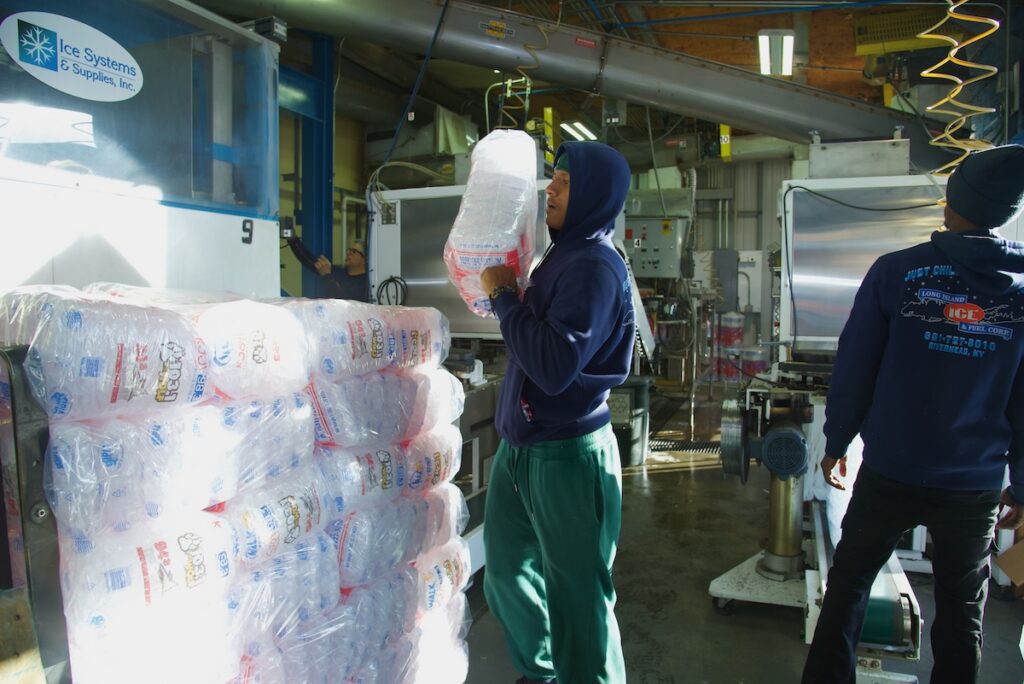
Since 2004, when Andrew Conklin, Kyle’s son, joined the company, the sixth generation has been teaming up with the fifth (Kyle and Chris) to run the place. Andrew, the daily operating manager, is responsible for labor, including the supervision of 70 workers driving 20 delivery trucks during the summer season. Megan, Chris’s daughter, uses her background in accounting to keep the office running efficiently and oversees the purity, testing and traceability of the ice. Megan’s brother Josh manages Montauk deliveries and sales, and oversees freezer refurbishment.
“We all wear a lot of hats,” says Megan. One hopes they are insulated.
Some of Long Island Ice & Fuel’s best customers clue you in to how very specialized their work is. Commercial bakeries, for instance, have a distinct need for ice to control the temperature of dough. These customers require absolute assurance the ice they buy is food-safe right down to the packaging, which means they need heat-sealed bagged ice instead of bags sealed with rings or twist-ties that could contaminate their dough.
“We make a heat-sealed bag just for bakeries,” says Andrew. “We used to do Entenmanns. A heat-sealed bag is not common in the Northeast.”
Ice Is Food
At Long Island Ice & Fuel, employees don’t think of their product as a convenience or a commodity.
“Ice is a food,” Megan says, “and it’s classified and regulated as a food.” She points out that mold and bacteria can grow on ice just as it can on most other foods, and that storing ice at the low temperature of a typical home freezer causes clear ice to crystallize. Ice can become contaminated from handling and can take start to smell like the foods it’s stored with. If you’ve ever noticed, say, the scent of striped bass on ice stored with the fillets from your latest fishing trip, you know what she’s talking about. And don’t get Megan’s uncle Kyle started on gas stations and restaurants that make their own ice.
“You will never see me buy ice from a no-name gas station machine,” he vows.
New ice-making technology is creating an easier path to pass responsibility from the fifth generation to the sixth. Kyle Conklin may be a born-and-bred iceman but he likes going south in the winter, so a computer engineer, working alongside a refrigeration engineer, have developed a control system for the factory that Kyle is able to use remotely while on trips to warm his bones.
“I can access it from my phone,” he says. “If I don’t like a pressure, I can turn on a fan to adjust it.”
But instead of it feeling like a tug on the reins, for Kyle, Megan and Josh, it’s more like finding new ways to strengthen their team effort.
“My dad likes to go to Florida and he can monitor what we are doing. The whole plant can be controlled from a computer screen,” Andrew says. “And yes, he calls us first.”
Meanwhile, Andrew’s children, Greyer, 5, Harrison, 3, and Hayes, 4 months, are too young to say for sure if they will join the family business, but there has already been talk of letting them sit on a truck to see how it feels.
With gloves, of course.