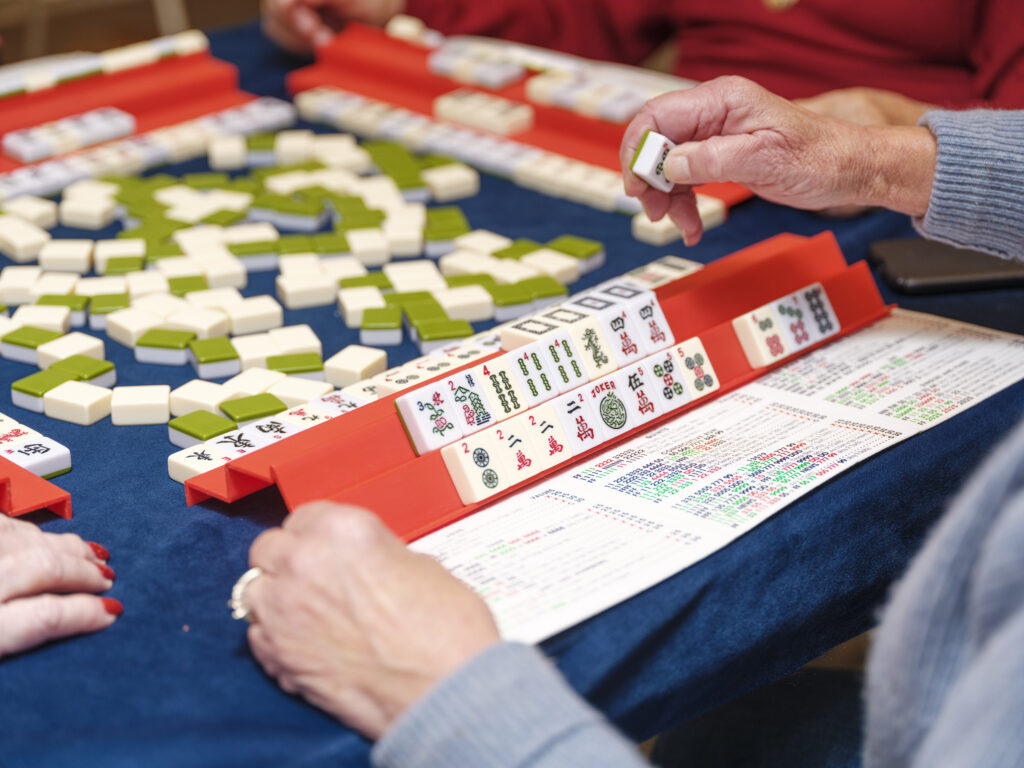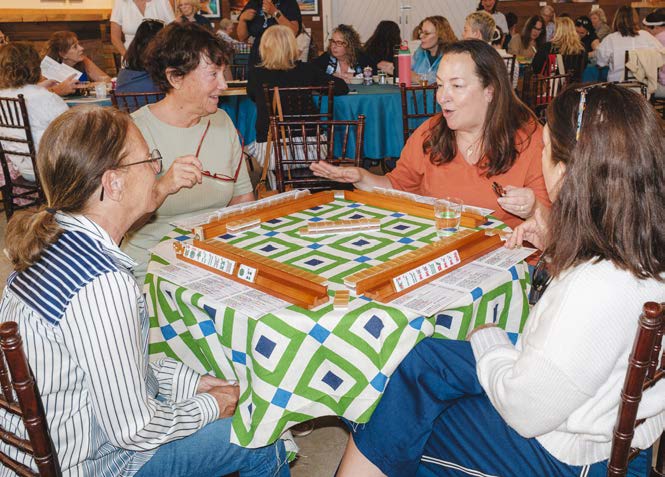
It’s eyes on the prize — or winning hand — for competitive folks until you’re seated at a table covered in 152 tiles of different suits, symbols, numbers, letters and designs.
The words dots, bams, cracks, winds, dragons, flowers and jokers all sound like text pulled straight from a fairytale until the moment that first meld (that is, your hopeful winning grouping of tiles) comes together and the strategy starts to take shape.
If you’ve ever taken a mahjong lesson, trying to piece together the directions might feel intimidating at first, but the nationwide rise in players who are prevailing and learning to love the game is hard to ignore. Based on a recent report from Yelp, the consumer review and local business discovery platform, searches for mahjong clubs were up 4,467% in 2026, while offers for mahjong lessons went up 819%.
The national phenomenon with deep-rooted history dates to the 1800s, when it was developed in southern China. In the 1920s, a craze began in the United States when American businessman Joseph P. Babcock introduced the game here, according to reporting by Claire Wang for National Geographic. Over the last century, the game has spurred over 40 iterations globally, intersecting with broader conversations around gender, cultural identity, racial prejudice and marginalized communities.
In 1937, a group of Jewish women in New York City standardized the rules of the American version of the game, creating The National Mah Jongg League. It has since published an annual official card, sold for $15, that sets the rules and winning hands for the year.
A GROWING EAST END TREND
On the East End, a few mahjong mavens are at the helm of communities connecting through the game.
Stacy Kostoulas, a Long Island native who now resides in Naples, Fla., spends summers on the North Fork. As a full-time mom, she learned the game as an outlet just over a year ago, making unlikely but welcomed friendships. The camaraderie inspired the recent creation of NoFo Mahj Club.
“Mahjong has been such a nice way for me to get out of my shell, connect with other ladies and just have something for myself other than just being a mom,” says Kostoulas.
As a former employee of Queensborough Community College’s Office of Student Engagement, Kostoulas has always had a knack for planning and coordinating orientations and new-student welcome events. Since June, she’s been hosting ticketed mahjong sessions where individuals can learn the game or participate in play at various North Fork locations, like Mint boutique on Love Lane in Mattituck, Aldo’s Coffee in Greenport and Main Road Biscuit Co. in Jamesport.


Photo Credit: JEREMY GARRETSON
On the South Fork, Liz Lachcik and Lindsay Carroll are leading Hamptons Mahj, hosting games and events with the help of other instructors and partnering with Wölffer Estate Vineyard in Sagaponack, where they held a series of lessons last fall.
“It’s a game that’s been around for centuries, not a new game,” Lachcik says. “Obviously there’s something about it that stands the test of time.”
Discovering so many South Forkers were eager to learn it led Lachcik and Carroll to host additional events at ColorPop Workshop’s Southampton location and the Maidstone Hotel in East Hampton. A series by the two is also running throughout the summer at The Pridwin and Ram’s Head Inn, both on Shelter Island.
Sunita Narma and Tracy Kessler, the hosts of NOFO Live, a weekly podcast celebrating the North Fork, are always seeking ways to take their virtual following into the real world and bring people face to face. Like many mahjong players, Narma is a fan of games at large. She plays bridge and canasta and picked up mahjong about two years ago.
“The older I get, the more I enjoy that it’s a way to keep your brain alive,” says Narma, who has learned both the American and Chinese versions.
In March, Narma and Kessler hosted their first mahjong meetup at The Shoals in Southold. They’ve since held two more, each attracting an increasing number of individuals coming to learn and play.
“It’s one of my personal philosophies to build a bigger table, and the more people that can sit across the table, that you can interact in your life with and share your life with, the better,” Narma says.
Lucille Metz, another lover of the American and Chinese game, has been a member of the drop-in mahjong group at the East Hampton Library for years and will be sharing her knowledge with patrons looking to learn Fridays through September at the library.
Metz, who was raised playing the game with her grandparents in Chinese gambling halls beneath restaurants in New York City’s Chinatown, started at five years old and never stopped.
“We grew up basically in the ‘60s and ‘70s and that’s all we did,” she says. “It was very different than children today, and children in the last few decades, because everything wasn’t electronic.”
She learned the American game later in life and loves sharing it, and the Chinese pasttime, with others.
“It’s been a lot of fun because we’re just spreading the love of mahjong,” says Metz, “no matter which way you slice it.”
TILE TALK 101
Under the Chinese version, typically spelled “mahjong,” and the American version, which follows the spelling of the national league’s title “mah jongg,” each game has four participants, with players drawing and discarding tiles to create winning combinations.
While similar at their core, American and Chinese tiles do differ: the American set of 152 has jokers and western numerals that match those on the National Mah Jongg League’s annual card. The Chinese set of about 144, meanwhile, has optional add-on flowers and seasonal tiles.
The American game has racks and pushers used to hold and conceal tiles and push them forward in the game; a wind indicator or dealer marker (to indicate the current dealer); and optional additional accessories like tile bags, scorecards and timers. Both versions are played with dice and the Chinese game also features a wind indicator, which is used only sometimes but lacks the racks when played traditionally.
At its origin, Hamptons Mahj was created to bring a unique look to the lineup.
“Depending on how deep you get into the mahjong world, sets are collectable and then the accessories are endless,” says Lachcik.
Due to the rising popularity of the game in southern states, bright-colored tiles are sold in bulk, Lachcik says. She and Carroll wanted to put a local spin on mahjong after learning the game to bring new life to their book club, so they embarked on the creation of a Hamptons-themed set.
The duo started with a classic line of tiles released this past November that featured nods to the East End, like cardinals, roses and martinis in place of traditional mahjong symbols. In late summer or early fall, Carroll and Lachcik will release their second Hamptons line with additional local references, upscale packaging and detailed designs on their website, hamptonsmahj.co.
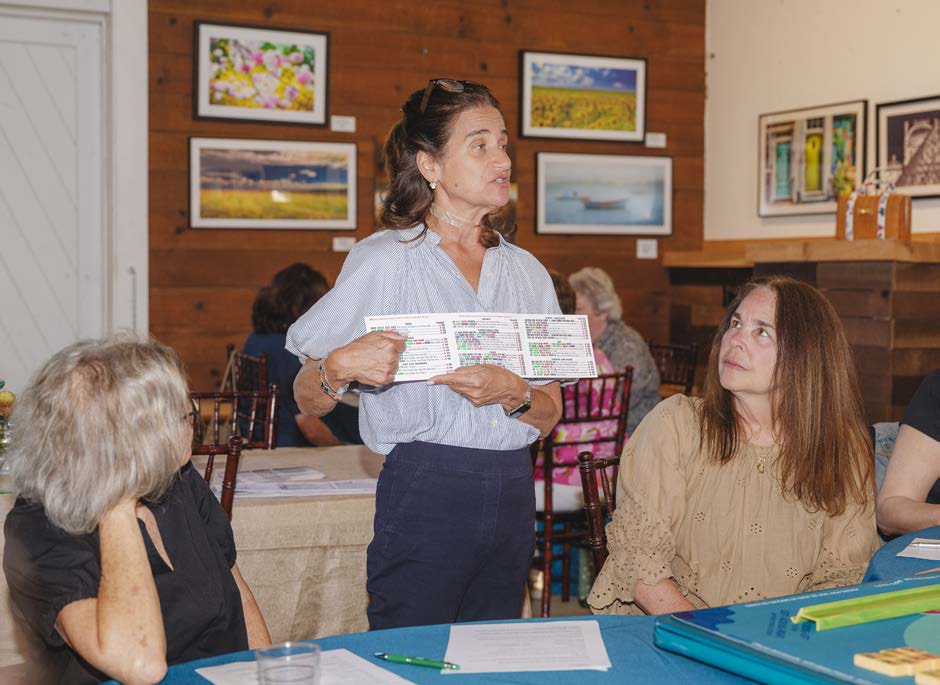
“It’s a game that’s been around for centuries, not a new game,” says Liz Lachcik, an instructor with Hamptons Mahj. “Obviously there’s something about it that stands the test of time.” (Photo credit: jeremy garretson)
CONVERTING THE MAHJONG-CURIOUS
The unique style of the Hamptons ladies’ tiles isn’t just aesthetically pleasing. They also help teach the game. Familiarity with the equipment is everything when it comes to strategy, pivoting, making melds and declaring a win or, in the American game, calling the coveted first “Mahjong!”
Whether you’re learning alongside friends, family or other ambitious first timers, all the East End instructors share this sentiment: “Come in with an open mind,” Metz says.
It takes getting past the overwhelming onset of understanding the tiles, flow of the game and strategy to get into a groove where you can soak up the social aspect and, in the case of East Enders, the beautiful settings in which the game is being played — something that Kostoulas, Lachcik and Narma attribute to part of mahjong’s popularity to on the island.
Some come to learn and satisfy their curiosity, but many also want to find a new connection point with others who live here. And the opportunities are ample these days on both forks, with plenty of events to jump in on. Plus, almost every East End library offers opportunities for open play.
“It’s really becoming a fun way for us to enjoy [being] together,” says Narma.