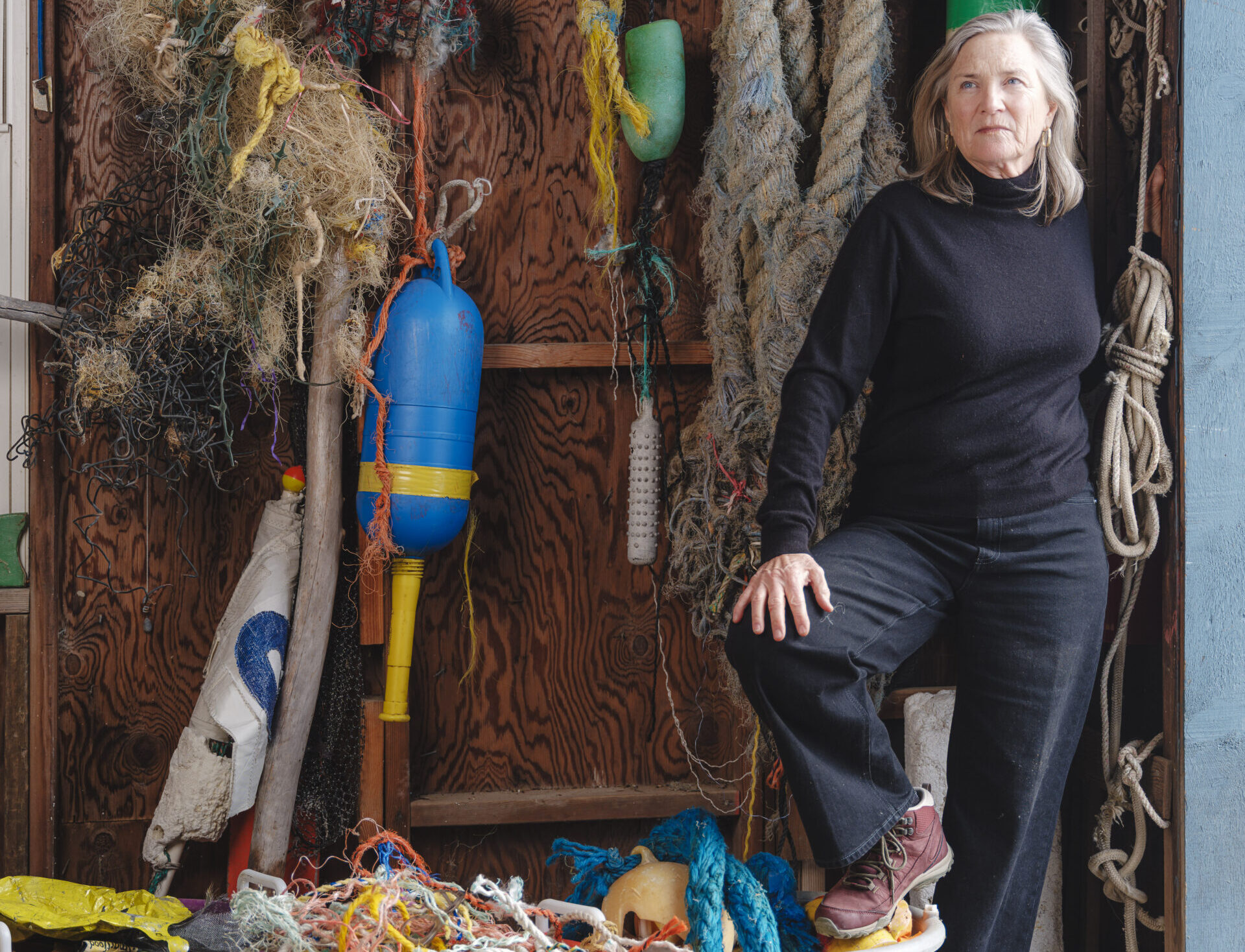
Cindy Pease Roe’s bayside art studio at Port of Egypt Marine is filled with the tools and supplies more typical to that of a shipyard workshop than a creator of fine art — except, of course, for the colorful, clean and organized shelves full of trash.
Roe, an artist who began her career as a traditional painter and sculptor, now uses marine debris as her medium, or, as she calls it, upsculpting. Reclaimed waste, mostly plastic from local beaches, is carefully washed, sorted and packed into labeled containers by Roe, her assistant Brianna Sander and various volunteers, with garbage-gathering assistance provided by groups like Surfrider Foundation and the Atlantic Marine Conservation Society.
Bottle caps, rope, lighters, straws, Styrofoam buoys, tampon applicators, old beach chairs, plastic utensils, bottles and bags are given a second life in Roe’s large-scale sculptures and art pieces meant to educate the public on the problem of ocean plastic pollution and inspire them to make their own changes.
Connection with the Sea
Roe spent much of her childhood on Cape Cod, where her family lived in an old sea captain’s house near the water. When her father, who worked for General Motors, was transferred from New York City to Detroit, the family moved to Michigan but kept their Cape Cod summers.
They loved to spend time by the water. “My mother was very creative,” Roe says. “She sewed all of my clothes and painted and spent significant time with me and my siblings outdoors.”
Roe enjoyed swimming, sailing, digging for clams and exploring the marshes and beaches with her friends. Eventually, she studied theater at Western Michigan University and lived and worked onboard an old wooden schooner for two years. While studying art at New York University, she practiced painting techniques gleaned from her mentor, Cynthia Knott, known for her luminous seascapes. The duo often painted en plein air on the South Fork, working at sunrise, sunset and during eclipses. “We were always looking for the light while painting the shorelines,” Roe says. She went on to produce nautical and environmental-themed work in oil paints, encaustic and photographic collages and other mixed media.


Artist Cindy Pease Roe draws on her lifetime of living near shorelines
and wanting to protect them for inspiration. (Photo credit: Jeremy Garretson)
A South Fork resident for many years, Roe moved to Greenport in 2010 and set up her studio next to Wooden Boatworks in Sterling Harbor, a boatyard specializing in the construction and restoration of wooden boats. Owned by Roe’s friends Don and Linda Costanzo, along with Don’s brother Bruce, the boatyard mirrored her brothers’ business, Pease Boatworks, on Cape Cod.
“The vibe and the smell of the place reminded me of the old sea captain’s house I grew up in,” says Roe. “I knew it would be a great place to live and work on the water, and I was right!”
Discovering a New Medium
As Roe continued to work on a series of oil paintings she had started in the early 2000s on traditional boatyards, she noticed mounds of garbage on the beach where she walked her dogs each morning. “I was shocked by the amount of plastic that I saw,” she recalls. “I started picking it up. I brought it back to my studio and started working with it.” Roe made a wreath out of the plastic debris and hung it up. “It took on a life of its own, and eventually there was more plastic in the studio than there were paintings.”
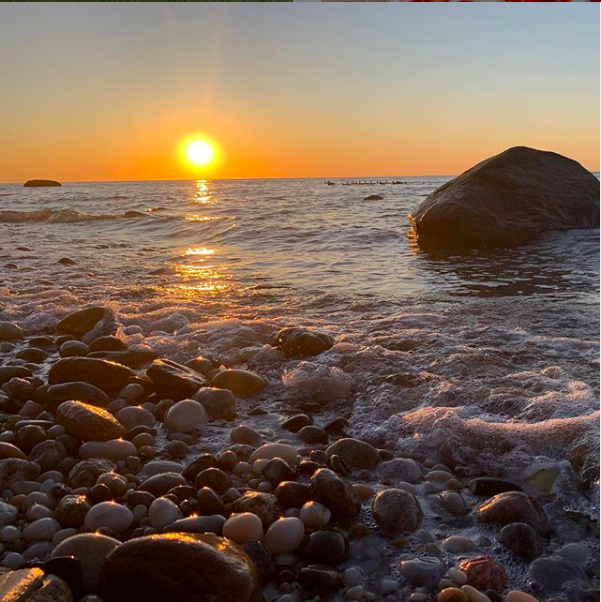
Roe found that Long Island Sound beaches in particular amass large amounts of debris because of the Sound’s depth and strong currents. Many rivers from the north also flow south into the Sound, carrying trash with them and adding to the buildup.
Working with the random plastic pieces that found their way to her was challenging but fun. As Roe recalled in an interview on WLIW’s Heart of the East End show, “Now, when I pick up plastics I can see it as a material: how I might use it, what its potential might be.” The oddest debris she’s ever found? A discarded prison ankle bracelet.
In 2017, Roe produced a sculpture of an osprey nest constructed from plastics found in a real toppled osprey nest. The current iteration of that work is called What’s Inside the Osprey Nest? and is permanently displayed at Watch Hill on Fire Island National Seashore. Her first large-scale sculpture — Herman the Turtle, in 2016 — was made from abandoned fishing nets, lures, pieces of plastic traps and other marine debris. (Herman can be seen in the rafters at Greenport Harbor Brewing Company in Peconic, where he permanently resides.)
That same year, Roe coined the term “upsculpt,” combining “upcycling” and “sculpting” to describe her environmentally conscious art. She formally created a nonprofit with the same name to educate and engage the public about the problem of plastic ocean pollution.
Viewing one of Roe’s large marine pieces is truly an experience.
“Her work is breathtaking to view in person,” says Sander, Roe’s studio assistant and UpSculpt’s director of education and community outreach. “Cindy uses materials to tell a story to viewers. I often witness people walk away with a new perspective on the state of our oceans and what we can do as a community to help curb plastic pollution.”
Roe believes the real message of UpSculpt is enlisting the community to protect the environment after they see her sculptures. “I realized as soon as I saw how much plastic was on our beaches that our community needed to be educated about the issue of plastics in the Long Island Sound,” she recalls.
Art for the Public
Roe has produced intriguing sculptures of deer, whales, ducks, egrets, flamingos, sharks, a chandelier reminiscent of an enormous jellyfish and a bluefin tuna called Big Daddy.
As her works have become larger and more intricate, some recent public art pieces are true standouts, like the 14-foot great white shark called Sugar, aka Mama Shug, located at Herring Cove Beach at Cape Cod National Seashore in Provincetown, Mass.
Sugar was constructed “100% out of unnatural materials picked up off the Cape Cod National Seashore,” Roe says. The shark has swim goggles for eyes, an old sneaker for a snout and a body made of straws, lighters and plastic utensils.


The Long Island Sound’s strong currents and depth have provided a wealth of material washing up on shore for Roe to work with. (Photo credit: Jeremy Garretson)
The great white shark sculpture was part of a series of marine debris artworks commissioned by the National Oceanic and Atmospheric Administration Marine Debris Program and selected in a juried competition by the National Parks Service, Cape Cod National Seashore and the Center for Coastal Studies in Provincetown.
Equally striking is Medusa, a 26-foot giant squid commissioned by the Whaling Museum & Education Center at Cold Spring Harbor with funding from the New York Council on the Arts. With a big orange-and-white traffic barrel for the squid’s body, museum visitors can take detritus-focused delight in identifying garbage like the beach toys, Mylar balloons, red Solo cups, sports equipment, caution tape and plastic bottles all cleverly incorporated into the piece.
Taking Action
Woven into the intricate knitting of objects, though, is the true fabric of UpSculpt’s mission: getting the public involved in fighting plastic pollution.
Educating young viewers in particular has always been one of Roe’s aims with the project. “I was inspired to educate as soon as I started working with marine plastics,” she recalls. “I knew that kids would enjoy cleaning the beaches and making artwork from what they picked up because it is fun.”
UpSculpt’s schedule of workshops and classes is designed to inspire and educate. “Engaging in grassroots community action is core to my mission as an artist,” Roe says.
Sander began working with Roe in 2022. An artist with a background in biological sciences who has conducted research on microplastic pollution, Sander assists Roe in presenting workshops, speaking at events, teaching virtual education sessions and hosting studio visits, as well as providing administrative assistance.
“It is a small organization,” Sanders says, “which means Cindy and I have to wear many hats in order to get it all done … she is a great creative mentor whose work has inspired me well before we started working together. It’s equally as rewarding to educate and work with our community.”
Roe’s work has taken her to Florida, Maine and China to deliver UpSculpt’s message on ocean pollutants, and she visited the Galapagos Islands this past winter. She acknowledges that “marine plastic pollution is everywhere and people are looking for solutions. Third-world countries and small island nations are most impacted and they have the least amount of resources to deal with marine plastics.”
The Art of Ecology
Roe’s work is part of a new exhibition, “Regeneration: Long Island’s History of Ecological Art and Care” at the Parrish Art Museum in Water Mill, on view until June 14. She’s one of 11 artists with ties to Long Island whose work acknowledges the issues now impacting the East End, like land development, trash in the environment and nitrogen pollution in our waters, along with the movement to protect native tree and plant species.
“I think Regeneration is an outstanding exhibition,” says Roe, noting its slate of diverse artists and varied approaches reflecting Long Island’s ecology. “The show feels layered and expansive. I’m truly honored to be included, especially as I’m showing some of my most recent work.”


Roe’s latest works are, fittingly, part of a new exhibit called “Regeneration: Long Island’s History of Ecological Art and Care” at the Parrish Art Museum in Water Mill. (Photo credit: Jeremy Garretson)
While they’re presented in a different form than her marine-animal sculptures, the striking pieces of Roe’s displayed in the show were all still constructed with discarded marine debris, albeit in a more elegant manner. Her hanging sculptures, made of rope-wrapped buoys, life rings, a discarded outrigger and long-forgotten Mylar balloons, conjure notions of once-useful equipment lost at sea and refashioned for a different, more environmentally conscious purpose.
Also at the Parrish show is a community weaving project Roe organized that encourages visitors to collaborate by weaving a few strips of discarded rope or plastic on a large loom. Each woven piece will become part of a future UpSculpt installation as the nonprofit continues to make their message heard.
This particular ongoing project is more than an earnest effort to collectively draw observers to become advocates or to continue Roe’s mission. Its theme speaks to her mission-driven work as an artist and as a human being. A quote she’s fond of by Chief Si’ahl (Chief Seattle) of the Suquamish and Duwamish Indigenous peoples of Washington State perhaps best sums up Roe’s philosophy and life’s work: “Humankind has not woven the web of life. We are but one thread within it. Whatever we do to the web, we do to ourselves.”